“Will laser burn my skin?” and “Does it work on Indian skin?” are the two questions we hear most about laser hair removal. The short answer is that it works well on wheatish and brown skin, if it is planned for brown skin. Here is the longer answer.
Why skin colour matters
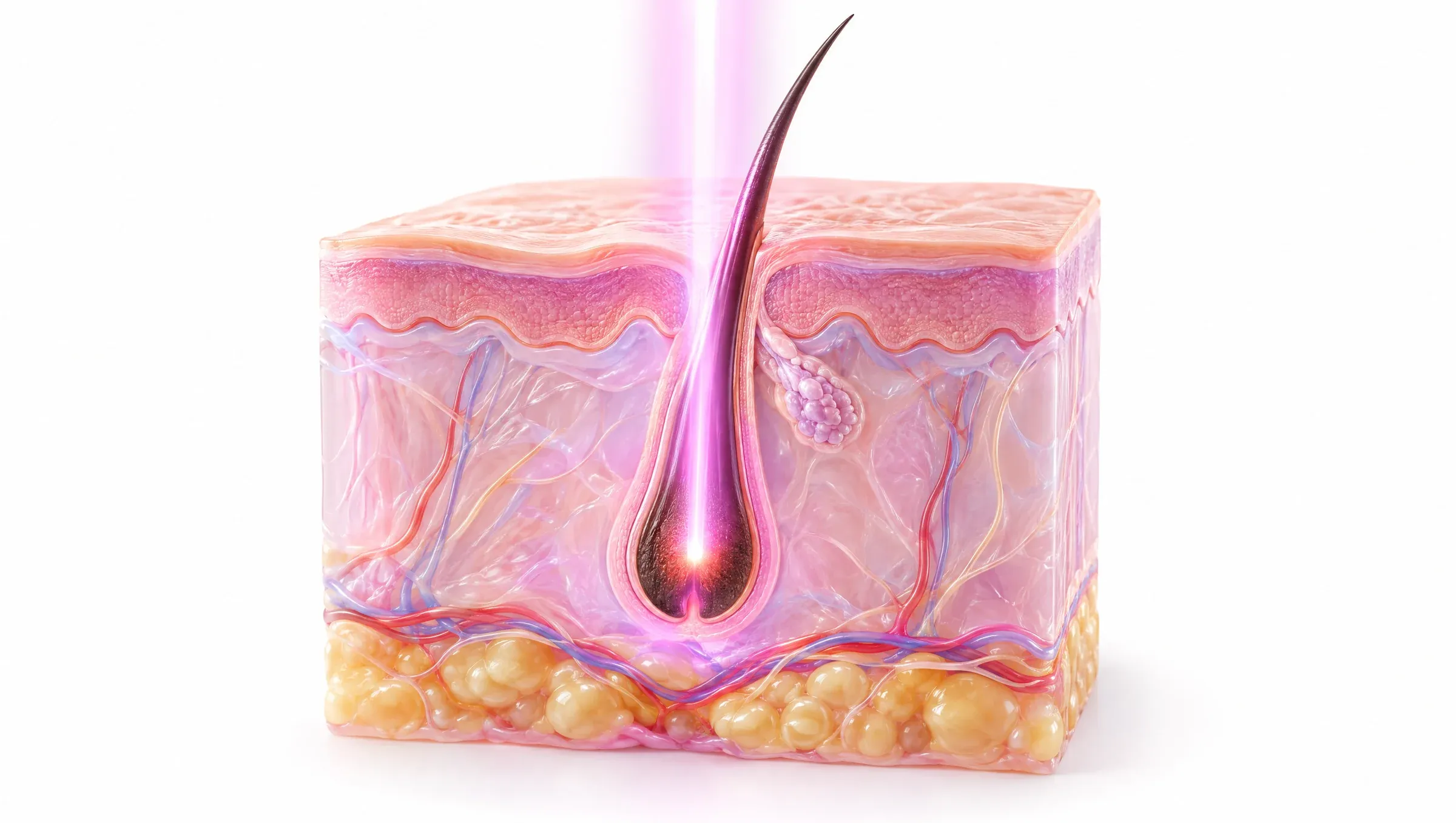
A hair-removal laser targets melanin, the pigment in the hair root. Its light is absorbed by the pigment, which heats and disables the follicle.
The catch is that skin also contains melanin, and brown skin contains more of it. If too much laser energy is absorbed by the skin rather than the hair, the result can be burns, blisters, or dark or light patches. Older lasers and careless settings made this common, which is where the idea that “laser isn’t for Indian skin” comes from.
Modern lasers and techniques have changed that. The aim is simple: get enough energy into the hair while protecting the skin.
Indian skin types
Dermatologists describe skin by how it reacts to sun, from type I (always burns, never tans) to type VI (deeply pigmented, never burns). Most people in Gujarat and across India are types III to V: they tan easily and burn rarely. That is exactly the range where laser choice and settings matter most.
Which lasers suit brown skin
- Diode lasers (around 800–810 nm): reach slightly deeper and are absorbed a little less by surface pigment. With contact cooling and an in-motion technique, they suit a wide range of Indian skin. At OrnaSkin we use the Alma Soprano ICE.
- Alexandrite lasers (755 nm): absorbed strongly by hair pigment, so effective on finer dark hair. Traditionally used on lighter skin, but gradual, in-motion delivery such as the DEKA Motus AX “Moveo” technique allows careful use on many Indian skin types. Read more about the Motus AX.
- Long-pulsed Nd:YAG lasers (1064 nm): absorbed least by surface pigment, often chosen for very dark skin, though they can feel less comfortable and are less effective on fine hair.
The doctor matches the laser to your skin type, hair colour and thickness, and the area.
What makes it safe
- A medical assessment first: skin type, hair, medicines, hormones, history of pigment problems or keloids.
- A test patch when in doubt, checked after a few days.
- Conservative starting settings, increased gradually over sessions.
- Cooling throughout treatment.
- No tanning before or after, and daily sunscreen.
- No waxing or plucking during the course, so the hair root is there to target.
Real risks, and how common they are
- Redness and bumps around follicles for a few hours: common and expected.
- Temporary darkening (post-inflammatory hyperpigmentation): more likely on brown skin, especially with sun exposure; usually fades over weeks to months.
- Blisters or burns: uncommon with correct settings and cooling.
- Lightening of the skin: uncommon and usually temporary.
- Paradoxical hair growth: a rare increase in fine hair near treated areas, reported more often on the face and neck in darker skin types. It is treatable.
Tell the clinic promptly about blistering, crusting or patches, so they can be managed early.
Will it work for my hair?
Laser works best on dark, coarse to medium hair. It works less well on very fine hair, and poorly on grey, white, red or blonde hair, which have little pigment. For Indian skin, the good news is that most body and facial hair is dark.
PCOS and facial hair
Excess facial and body hair in women is often linked to PCOS or other hormonal causes. Laser helps a great deal, but hormones keep stimulating new hairs, so:
- a doctor should check for and treat the underlying cause;
- more sessions and maintenance top-ups may be needed.
See unwanted hair for more on hormonal hair growth.
How many sessions, and what results to expect
Most people need six to ten sessions depending on the area, spaced roughly four to eight weeks apart. Hair becomes sparser, finer and slower to grow; most people see a clear reduction after two or three sessions. A long-term reduction is realistic; every last hair gone forever is not a promise anyone should make.
Laser hair removal in Rajkot
At OrnaSkin, laser hair removal is planned by a dermatologist on two different lasers, so the right one can be chosen for your skin. Read about sessions, preparation and the cost range on our laser hair removal page, and how to prepare and care for your skin.