
How a pico laser works
Pigment lasers work by sending light that is absorbed by melanin or ink, which breaks it into particles small enough for the body to clear. What makes a picosecond laser different is speed: each pulse lasts only a few hundred trillionths of a second. The energy arrives so fast that pigment shatters from a pressure wave as much as from heat, into finer particles, while less heat spreads into the surrounding skin.
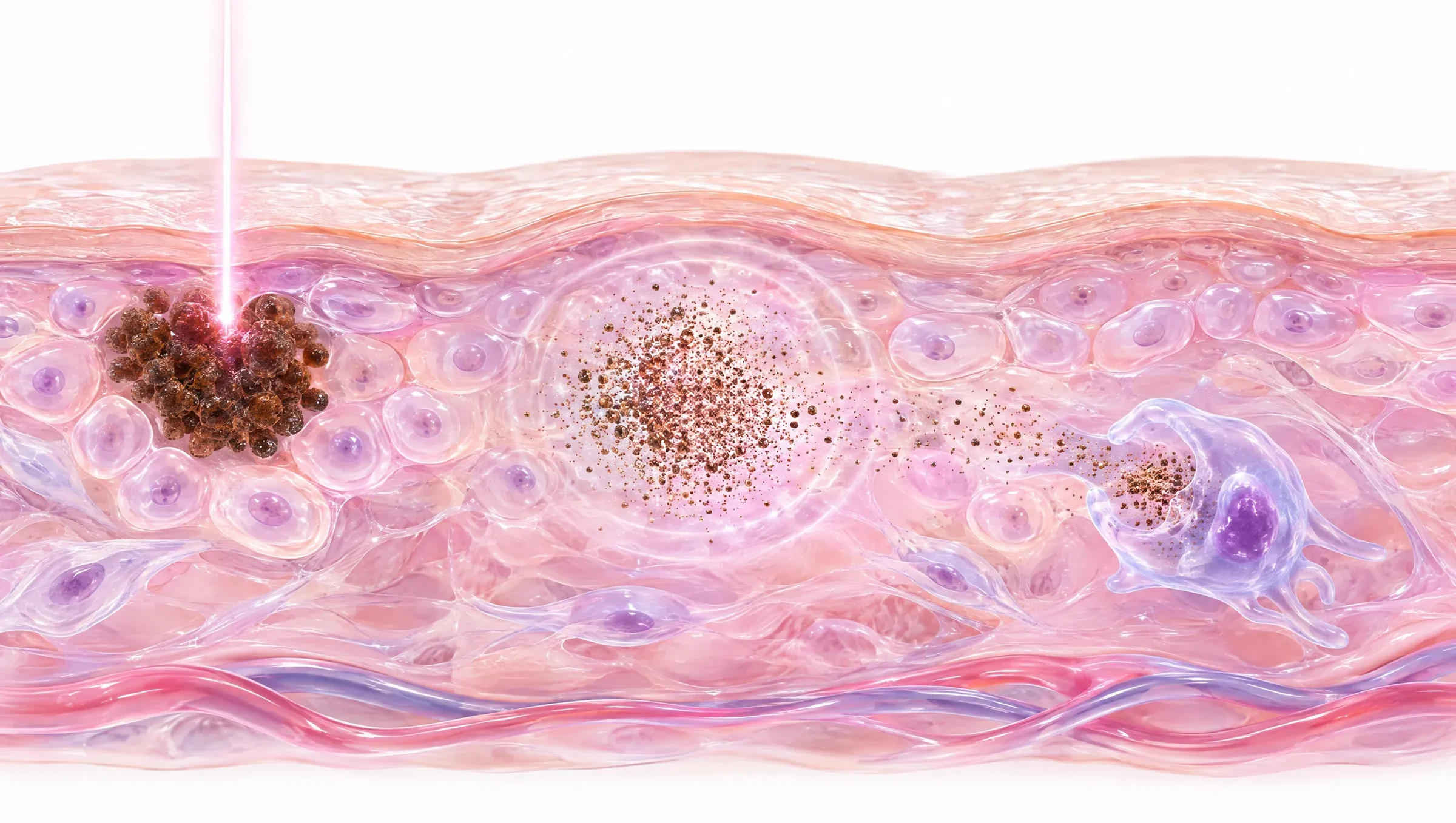
- A picosecond pulse is absorbed by the pigment.
- Its pressure wave breaks the pigment into very fine fragments.
- The body clears the fragments gradually between sessions.
- Pulse length
- Billionths of a second (nanoseconds)
- How it breaks pigment
- Mostly heat: pigment absorbs the energy and cracks into smaller pieces
- Heat in the skin
- Moderate. More heat spreads into the surrounding skin
- Often used for
- Laser toning, freckles, sun spots and many tattoos. A proven workhorse, used at low settings for melasma
- Pulse length
- Trillionths of a second (picoseconds), many times shorter
- How it breaks pigment
- A pressure wave as much as heat: pigment shatters into much finer particles that the body clears
- Heat in the skin
- Lower. Less heat reaches the surrounding skin, which matters for brown skin
- Often used for
- Stubborn pigmentation, pigment that hasn’t responded to other lasers, and skin renewal
Illustration, not to scale. Both laser types have a place; the dermatologist chooses the laser and settings for your pigment and skin type, and some pigment, such as melasma, needs a gentle, long-term plan with either.
At OrnaSkin, this is done on a DEKA picosecond laser at the Madhur Nagar clinic. The same laser can be used with a fractional handpiece, which creates tiny pockets of energy inside the skin to improve texture, fine lines and pores with little downtime.
What it can help with
- Freckles, sun spots and age spots.
- Stubborn pigmentation, including pigment that hasn’t responded well to other treatments.
- Melasma, at gentle settings, as part of a long-term pigmentation plan.
- Uneven tone and dull skin, for a brighter, more even look.
- Texture, fine lines and pores, as skin renewal.
For routine laser toning, a Q-switched laser is often just as suitable. The dermatologist chooses between them for your pigment and skin.
What results to expect
Same day
Pinkness and warmth; treated spots may look slightly darker.
Week 1
Darkened spots flake off; skin looks clearer.
Through the course
Pigment lightens gradually with each session, 3–4 weeks apart.
Maintenance
Daily sunscreen; occasional sessions for melasma or new sun spots.
Results vary with the type and depth of pigment, skin type and sun exposure. Melasma and hormonal pigment usually need ongoing care.
Who it suits
Adults with freckles, sun spots, stubborn or mixed pigmentation, or uneven tone and texture, including people with brown skin, for whom lower heat is useful. It is planned carefully for melasma.
It is avoided during pregnancy, over a recent tan or sunburn, on active infection or cold sores in the area, and if you are taking medicines that make the skin sensitive to light, or have recently taken isotretinoin (unless the dermatologist advises otherwise). Tell us about all your medicines and any history of keloids or skin darkening after injury.
Before, during and after
Before
Avoid sun exposure and tanning for two to four weeks before, and stop retinoids and exfoliating acids a few days before, unless told otherwise. If your skin darkens easily, a preparation cream may be started first.
During
You wear protective eye shields. A numbing cream may be applied for stronger treatments. The laser handpiece is passed over the skin, with quick snapping sensations, and a cooling or soothing cream is applied at the end. A face session takes about 20–30 minutes.
After
- Expect pinkness and warmth for a few hours to a day; spots may darken and flake within a week. Don’t pick them.
- Use a gentle cleanser, moisturiser and a broad-spectrum sunscreen every day.
- Avoid sun, saunas, scrubs and actives such as retinoids for a few days.
Risks and how we minimise them
Common effects are temporary: redness, mild swelling and, rarely, pinpoint bleeding or small crusts. In brown skin, the main risks are temporary darkening (post-inflammatory hyperpigmentation) and, less often, lighter patches, especially with high settings or repeated aggressive treatment.
We reduce these risks by choosing settings for your skin type, starting conservatively, testing where needed, spacing sessions properly, preparing pigment-prone skin, and insisting on sun protection between sessions.