
OrnaSkin Madhur NagarBy appointment · Monday–Saturday, 10 am – 7:30 pm

Book a consultation

Skin concern

Hair fall

Losing 50 to 100 hairs a day is normal. Hair fall becomes a concern when shedding increases for weeks, the parting widens or the hairline recedes. Common causes are genetic thinning, stress or illness, thyroid problems, low iron or vitamins, and PCOS. Finding the cause, sometimes with blood tests, decides the treatment.

In the skin

The hair cycle, and what goes wrong

Illustration, not to scale. Layers from top: outer skin (epidermis), dermis, fat.

Normal shedding or hair loss?

Every hair grows for a few years, rests for a few months and then falls out, to be replaced by a new one. At any moment most hairs are growing, so losing 50 to 100 hairs a day is normal, and more on days you wash or comb it out.

Hair fall becomes a concern when:

  • shedding is clearly heavier than usual for more than a few weeks;
  • your parting looks wider, or your scalp shows through more in photos or bright light;
  • your hairline is receding or the crown is thinning;
  • you notice smooth, round bald patches;
  • your ponytail feels thinner, or hair breaks easily.
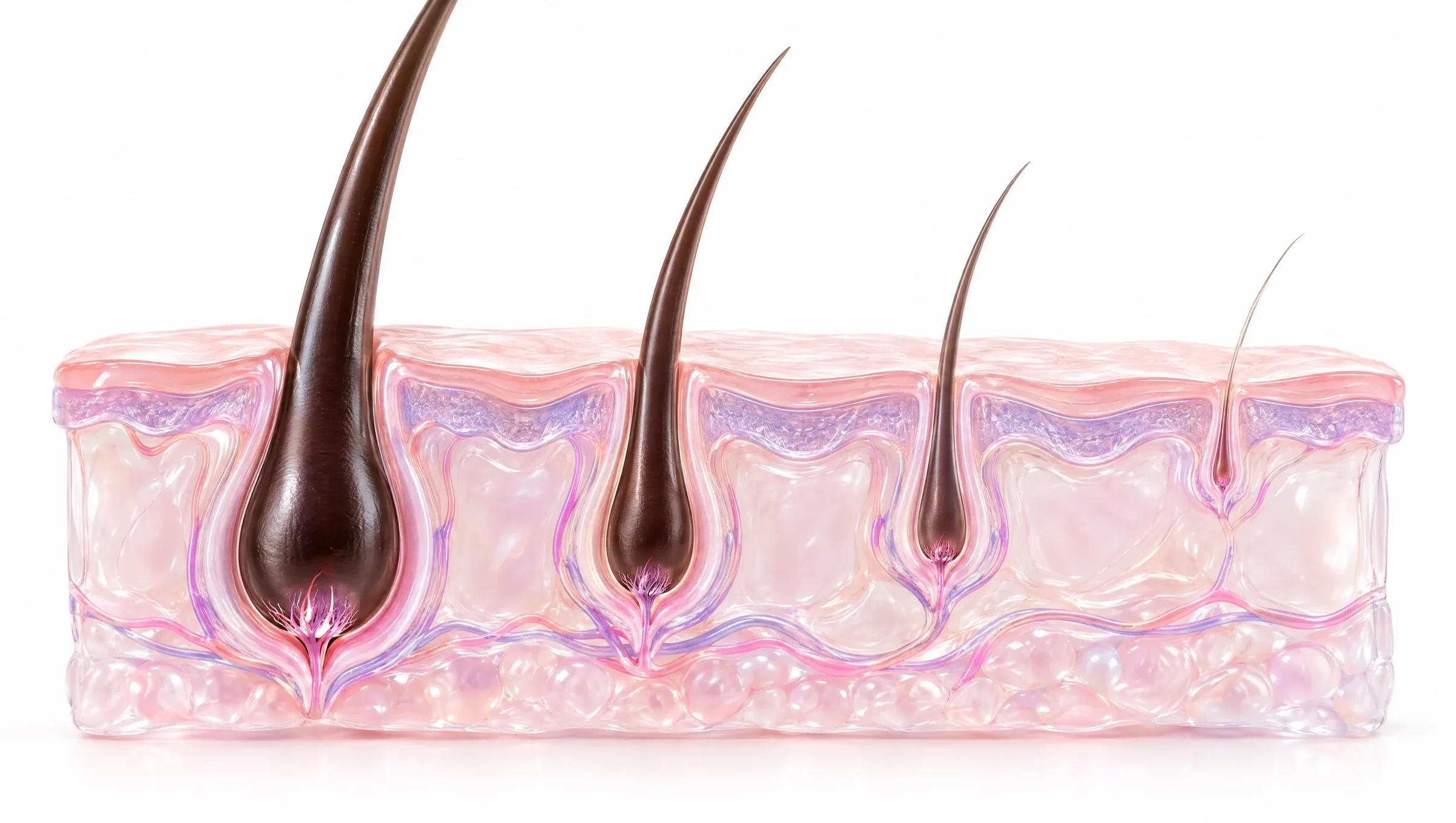
Illustration: a row of hair follicles that become smaller from left to right, from a thick hair with a large root to a fine, short hair.
Illustration
  1. A healthy follicle grows a thick hair from a large root.
  2. In pattern thinning, follicles shrink a little with each growth cycle.
  3. The hairs become finer and shorter, so the scalp shows through more.

What pattern is your hair loss?

The pattern is one of the best clues to the cause.

Which pattern fits?
↑ FRONTEVEN THINNING ALL OVER

Shedding all over

What it usually is
Telogen effluvium: sudden, diffuse shedding two to three months after a trigger such as high fever, illness, surgery, childbirth, crash dieting or major stress.
Worth checking
Iron (ferritin), thyroid, vitamin D and B12, and any new medicines.
Outlook
Usually settles within about six months once the trigger has passed, and hair regrows. Long-lasting shedding needs a closer look.
↑ FRONTRECEDING TEMPLES, THIN CROWN

Receding & crown

What it usually is
Male pattern hair loss (androgenetic alopecia): a receding hairline at the temples and thinning at the crown, often running in the family.
Worth checking
Usually diagnosed by examination; blood tests if shedding is heavy or other symptoms are present.
Outlook
Gradual and progressive without treatment. Medicines, PRP and other treatments started early slow it and can help regain some thickness.
↑ FRONTWIDENING PARTING

Widening parting

What it usually is
Female pattern hair loss: gradual thinning over the top with a wider parting, while the front hairline usually stays.
Worth checking
Iron, thyroid and vitamins, and hormones if periods are irregular or there is acne or excess hair (PCOS).
Outlook
Slowly progressive; treatment works best started early and continued.
↑ FRONTROUND, SMOOTH PATCHES

Round patches

What it usually is
Alopecia areata: smooth, round bald patches that appear quickly, caused by the immune system. In children, a scaly patch may be a fungal infection instead.
Worth checking
An examination of the scalp, nails and other hair; sometimes thyroid tests. Scaly patches may need a fungal test.
Outlook
Small patches often regrow, and treatment can speed this up. See a dermatologist early.

Illustrations of the scalp from above, not to scale. Many people have more than one cause at the same time, for example shedding after an illness on top of early pattern thinning.

Common causes of hair fall

  • Genetics and hormones: pattern hair loss in men and women, the most common cause of long-term thinning.
  • Illness and stress: fever, infections such as dengue, typhoid or COVID, surgery and major stress cause temporary shedding.
  • Childbirth: post-partum shedding, usually temporary.
  • Nutrition: low iron, vitamin D or B12, low protein and crash diets.
  • Thyroid problems and PCOS. Our post on hair fall in women explains these and the other common causes in women.
  • Medicines, including some for blood pressure, mood and acne, and stopping the contraceptive pill.
  • Scalp conditions: severe dandruff, psoriasis or fungal infection.
  • Hair care: tight hairstyles (traction alopecia), harsh chemical treatments and heat styling cause breakage and, over time, loss at the hairline.

Tests that may help

Not everyone needs tests. When the cause isn’t clear, or shedding is heavy, a dermatologist may suggest a blood count, ferritin (iron stores), thyroid function, vitamin D and B12, and in women with irregular periods or acne, hormone tests. A scalp examination with a dermatoscope (trichoscopy) shows the follicles and helps tell the types apart.

When to see a dermatologist

See a dermatologist if shedding has lasted more than two to three months, if you notice thinning, a widening parting or a receding hairline, if you have bald patches or a scaly, itchy scalp, or if hair loss is affecting how you feel. Early assessment matters, because treatments work best while follicles are still active.

Caring for your hair meanwhile

  • Eat regular meals with enough protein, iron-rich foods and fruit and vegetables; avoid crash diets.
  • Wash as often as your scalp needs; washing doesn’t cause hair loss, it only removes hairs that were already shed.
  • Avoid tight ponytails, buns and braids, and limit heat styling, straightening and chemical treatments.
  • Treat dandruff with a medicated shampoo.
  • Don’t start supplements or hair-growth products without knowing the cause.

How OrnaSkin treats hair fall

At OrnaSkin Madhur Nagar, the dermatologist finds the cause first, with a scalp examination and tests if needed, then plans treatment that may combine medicines with in-clinic treatments such as PRP for hair, mesotherapy and exosomes. Read about hair fall treatment for sessions and typical costs.

Your dermatologist

Dr. Smit Thakkar

MBBS, DDVL · Consultant dermatologist · leads OrnaSkin

At our Madhur Nagar skin clinic you are seen by Dr. Smit Thakkar himself, who examines your skin, explains your options plainly and plans the treatment with you.

About Dr. Smit Thakkar

Questions about hair fall

How much hair fall is normal?

Losing about 50 to 100 hairs a day is normal, and more on hair-wash days. It is worth seeing a dermatologist if you notice clumps in the shower or on the pillow for several weeks, a widening parting, a receding hairline, thinning at the crown or bald patches.

I had dengue, typhoid or COVID and now my hair is falling. Will it grow back?

Usually, yes. A high fever or major illness can push many hairs into the resting phase at once, and they shed two to three months later (telogen effluvium). The shedding typically settles within about six months and hair regrows, though it may take a year to look full again. A check for iron, thyroid and vitamins helps.

Does hair fall after delivery stop?

Yes, in most women. Shedding often starts two to four months after childbirth and settles by about a year. If it continues beyond that, or the parting is widening, see a dermatologist to check for low iron, thyroid changes or pattern thinning.

Can hair oil or a new shampoo stop hair fall?

Oils and shampoos can improve scalp comfort and hair condition, but they don't treat the causes of hair loss such as genetics, hormones or deficiencies. Dandruff treatment can help when an itchy, flaky scalp is part of the problem.

Are biotin and hair vitamins useful?

Only if you are deficient. Biotin deficiency is rare, and high-dose biotin can interfere with some blood tests, including thyroid tests. It is better to test for common deficiencies such as iron, vitamin D and B12 and correct what is actually low.

Can hair loss from pattern baldness be reversed?

Pattern thinning can be slowed, and some lost thickness regained, with treatment started early. Follicles that have been inactive for many years are unlikely to recover, which is why early treatment matters; a transplant is an option for advanced baldness.

Is hair fall in women different from men?

Often, yes. Men's pattern hair loss usually shows as a receding hairline and thinning crown. Women more often notice a widening parting and overall thinning on top, and hormonal causes such as PCOS, thyroid problems, low iron and childbirth are more often involved.

Further reading

References

  1. Evaluation and diagnosis of the hair loss patient. Part I: history and clinical examination. Mubki T, Rudnicka L, Olszewska M, Shapiro J. Journal of the American Academy of Dermatology, 2014;71(3):415.e1–415.e15
  2. Telogen effluvium: a review of the literature. Asghar F, Shamim N, Farooque U, Sheikh H, Aqeel R. Cureus, 2020;12(5):e8320

This page explains a treatment in general terms and is not a diagnosis or a promise of results. Results vary from person to person. A dermatologist decides what is right for you after examining your skin. Read our medical disclaimer and editorial policy.

Treatments for hair fall.

Hair restoration

Hair fall treatment

Hair fall treatment at OrnaSkin starts by finding the cause, such as genetic thinning, stress, thyroid problems, low iron or vitamins, PCOS or a scalp condition, often with blood tests and a scalp check.

From ₹7,000 a session

Hair restoration

PRP for hair

PRP (platelet-rich plasma) for hair uses a small sample of your own blood, spun to concentrate the platelets, which are then injected into thinning areas of the scalp.

From ₹7,000 a session

Clinical dermatology

Dermatology consultation

A dermatology consultation is a visit with a qualified skin specialist for any skin, hair or nail problem, from acne, eczema, fungal infections and hives to hair loss and nail changes.

₹1,200 per visit
All treatmentsExplore every treatment at OrnaSkinLasers, skin, hair and injectables, planned by a dermatologist in Rajkot.See all

By appointment Dr. Smit Thakkar

Not sure what you need? Start here.

Book a consultation at OrnaSkin Madhur Nagar. Tell us what you would like to change and we will plan it with you.

Your bag

Your bag is empty.

Browse Orna Skincare