Shaving, waxing and threading all work, but only for days or weeks. Laser hair removal aims for something longer: fewer, finer hairs that grow back slowly, if at all. How well it works, and how comfortable it is, depends a lot on the laser used and on how it is set for your skin. This guide explains one of the two lasers we use at OrnaSkin, the DEKA Motus AX.
What kind of laser is the Motus AX?
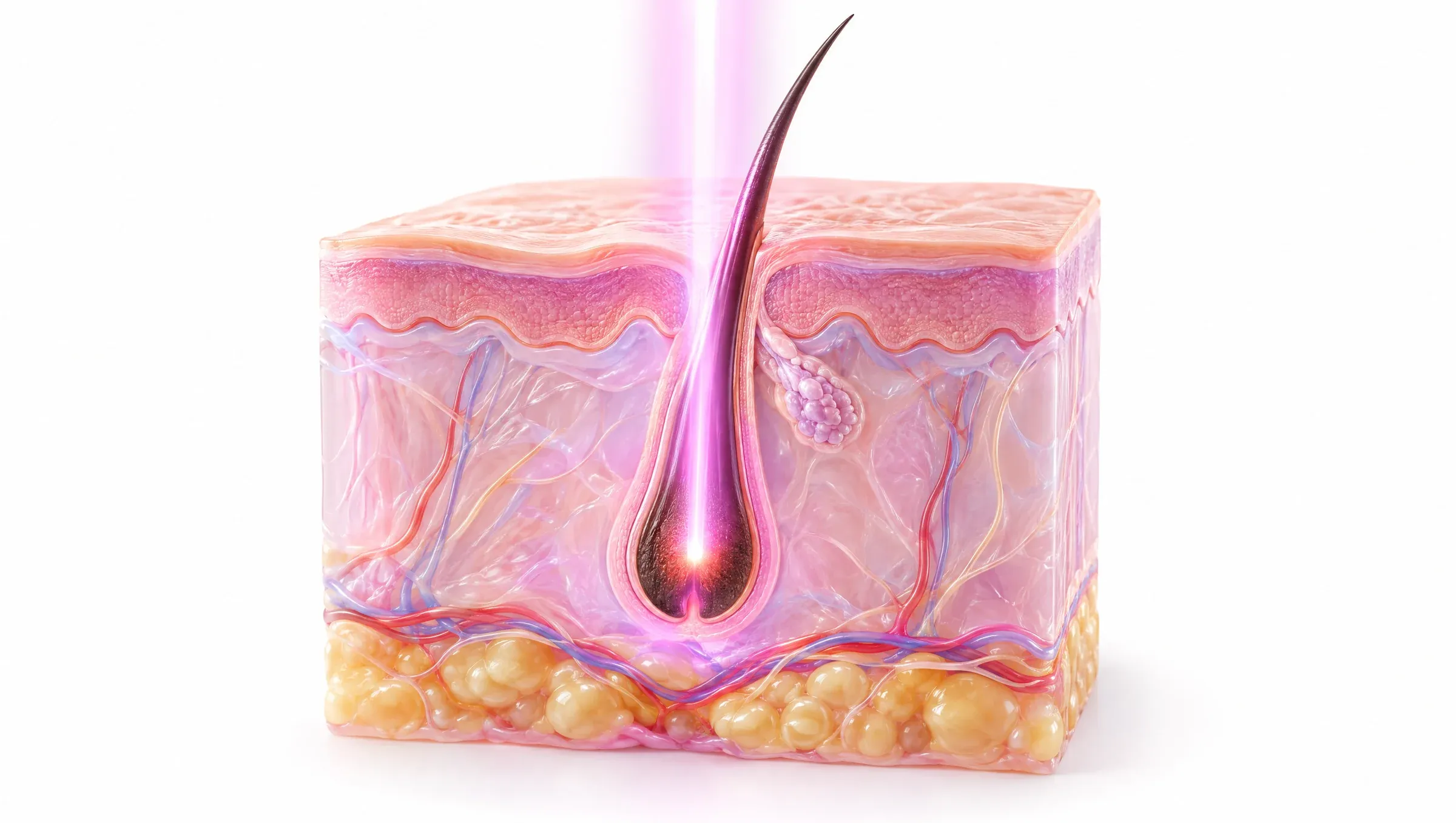
The Motus AX is an alexandrite laser, which produces light at a wavelength of 755 nanometres. Light at this wavelength is absorbed strongly by melanin, the pigment that gives hair its colour. When the laser passes over the skin, the pigment in each hair absorbs the light and turns it into heat. That heat travels down the hair shaft and damages the follicle that grows it, so the hair grows back weaker or not at all.
Alexandrite lasers have been used for hair removal for many years. What is different about the Motus AX is the way it delivers the light.
Gliding instead of zapping
Older hair-removal lasers usually fire one strong pulse at a time onto a spot of skin, then move on. Each pulse has to carry enough energy to damage the follicle in one go, which is what makes them feel like a rubber band snapping.
The Motus AX uses a technique its maker calls Moveo. The doctor or therapist keeps the handpiece moving over the area in passes, and the energy builds up gradually in the follicles. Because the skin surface is not hit with a single big burst, the treatment tends to feel like warmth rather than snapping, and the risk of surface burns is lower when settings are correct.
Why that matters for Indian skin
Brown skin also contains melanin, and that is the main challenge with laser hair removal in India. If too much energy is absorbed by the skin instead of the hair, the result can be burns or dark patches. The answer is not to avoid lasers, but to choose and set them carefully:
- the energy and pulse settings are matched to your skin type;
- the skin is cooled during treatment;
- a test patch is done first when there is any doubt;
- sun exposure and tanning before sessions are avoided.
The gradual delivery of the Motus AX helps here, which is one reason it is widely used on darker skin types when a dermatologist sets it. At OrnaSkin we also have the Alma Soprano ICE, a diode laser that works in a similar in-motion way. Having both means the laser can be chosen for your skin and hair rather than the other way round.
Does it work on fine hair?
Hair needs pigment for any laser to “see” it. Alexandrite light is absorbed by melanin more strongly than the longer wavelengths of diode or Nd:YAG lasers, so it often does better on finer dark hair, for example on the face, arms or in areas with mixed coarse and fine hair.
It will not work well on hair with little or no pigment. White, grey, red and very light blonde hair respond poorly to all lasers, and other options may be better.
How many sessions?
Hair grows in cycles, and a laser can only affect hairs in their active growing phase. At any one time only some of your hairs are in that phase, which is why one session is never enough.
- Most people need several sessions, often six to ten, spaced roughly four to eight weeks apart depending on the area.
- Results build gradually: hair becomes sparser, finer and slower to grow.
- Some people need an occasional top-up later, especially if hormones drive new growth.
Preparing for a session
- Avoid waxing, threading or plucking for a few weeks before, because the laser needs the hair root to be there. Shaving is fine.
- Shave the area a day before, or as advised.
- Avoid tanning and use sunscreen for the weeks before and after.
- Tell the doctor about any medicines, recent tanning, cold sores, or a history of keloids or pigment problems.
Aftercare
Mild redness and a feeling of warmth for a few hours are common. Use a gentle moisturiser and sunscreen, avoid hot baths, saunas and heavy exercise for 24 to 48 hours, and do not scratch or pick. Hairs may seem to “grow” for a week or two as treated hairs shed. Contact the clinic if you notice blistering, crusting or darkening.
Is it right for you?
The best way to find out is a consultation. The dermatologist looks at your skin type, the colour and thickness of your hair, the area and any hormonal causes (such as PCOS in women with facial hair), then recommends the laser and plan that suit you. Read more on our laser hair removal page, or see the lasers we use.