
Why wrinkles and fine lines form on the face
Young skin is held firm by a dense network of collagen and elastic fibres and plumped by water-binding hyaluronic acid. From the mid-twenties, the skin makes about one per cent less collagen each year, and sun exposure breaks down what is there faster. At the same time, the muscles of expression fold the skin in the same places thousands of times a day. Eventually, the skin no longer springs back fully, and a line remains.
Deeper changes add to this: fat pads under the skin shrink and slip, and the bones of the face slowly change shape, so folds deepen and hollows appear.
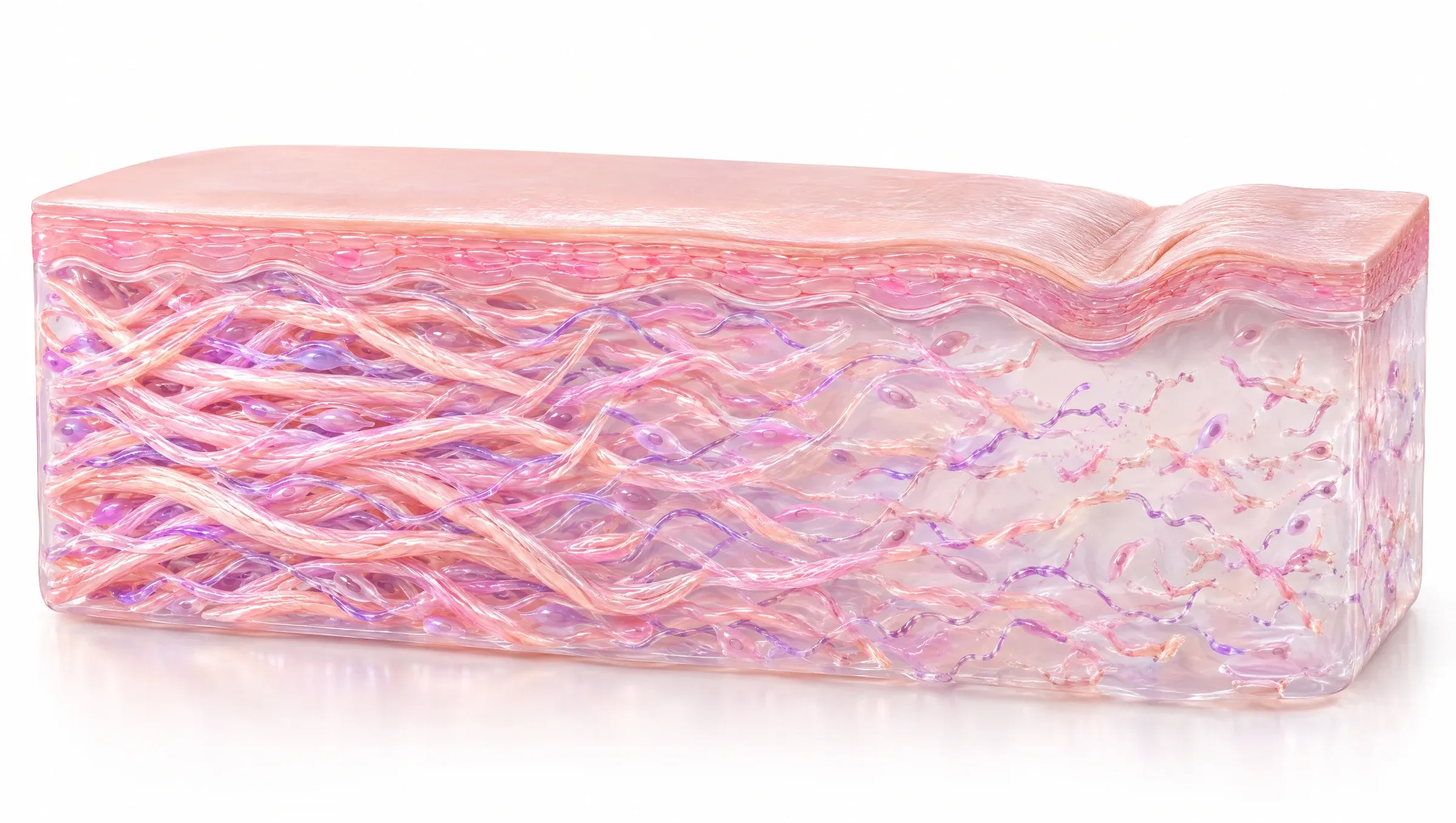
- Young skin: a dense network of collagen and elastic fibres.
- Collagen falls each year, and sun breaks it down faster.
- Repeated folding then leaves a line that no longer springs back.
What kind of lines do you have?
The type of line decides the treatment. A quick way to tell: look in the mirror with your face relaxed, then frown, raise your brows and smile.
Lines with expression
- How to tell
- Forehead lines, frown lines and crow’s feet that appear when you move and disappear when your face is relaxed.
- Why they form
- Muscles under the skin fold it in the same place over and over.
- What helps
- Anti-wrinkle injections that relax the muscle, so the line softens.
Lines at rest
- How to tell
- The same lines are still visible with your face relaxed.
- Why they form
- Years of folding plus collagen loss have etched the crease into the skin.
- What helps
- Injections to stop deepening, plus collagen-building lasers, radiofrequency or skin boosters, and sometimes a little filler.
Fine, crêpey lines
- How to tell
- Many fine lines and a papery texture, often under the eyes, on the cheeks and on the neck.
- Why they form
- Thinner, drier skin with less collagen and elastic tissue, often from sun damage.
- What helps
- Retinoids and sunscreen, skin boosters, fractional lasers and radiofrequency.
Deep folds
- How to tell
- Smile lines from nose to mouth, lines from the corners of the mouth, and under-eye grooves.
- Why they form
- Loss and shifting of volume under the skin, rather than expression alone.
- What helps
- Restoring support with fillers, tightening with HIFU or radiofrequency, and skin boosters for quality.
Illustrations, not to scale. Most faces have several types at once, which is why plans often combine treatments.
What speeds up wrinkles
- Sun: the biggest preventable cause of skin ageing, including in Indian skin.
- Smoking: breaks down collagen and narrows the skin’s blood supply.
- Pollution and heat.
- Rapid weight loss, which reduces the fat that supports the skin.
- Poor sleep and stress, and sleeping on the same side every night.
- Genes: some families age earlier or later.
When to see a dermatologist
There is no medical need to treat wrinkles, so the right time is when they bother you. A consultation is useful to understand which type of lines you have and what is realistic, before spending on creams or treatments, and to plan treatment that keeps your face looking like you.
Preventing new lines
- Use a broad-spectrum sunscreen of SPF 30 or more every day, and reapply outdoors.
- Use a retinoid at night if your skin tolerates it; start slowly.
- Moisturise; dry skin shows lines more.
- Don’t smoke, and sleep well.
- Wear sunglasses in bright light to reduce squinting.
How OrnaSkin treats wrinkles
At OrnaSkin Madhur Nagar, treatment is matched to your lines: Botox and anti-wrinkle injections for expression lines, skin boosters and Profhilo for fine, crêpey skin, dermal fillers for folds and hollows, and collagen-building RF skin tightening, HIFU and the erbium glass laser for texture and firmness.