
How laser hair removal works
Hair gets its colour from melanin, and melanin absorbs laser light. During a session, the laser passes through the skin and is absorbed by the pigment in the hair shaft and root. The light turns into heat, and that heat damages the parts of the follicle that grow new hair. The hair itself falls out over the next one to three weeks, and the follicle produces finer, slower hair afterwards, or none at all.
The skill lies in heating the follicle enough to disable it while keeping the surrounding skin safe. Indian skin also contains melanin, so the laser, its energy, the pulse length and the cooling all have to be matched to your skin type. That is why at OrnaSkin a dermatologist plans the treatment rather than a technician working from a chart.
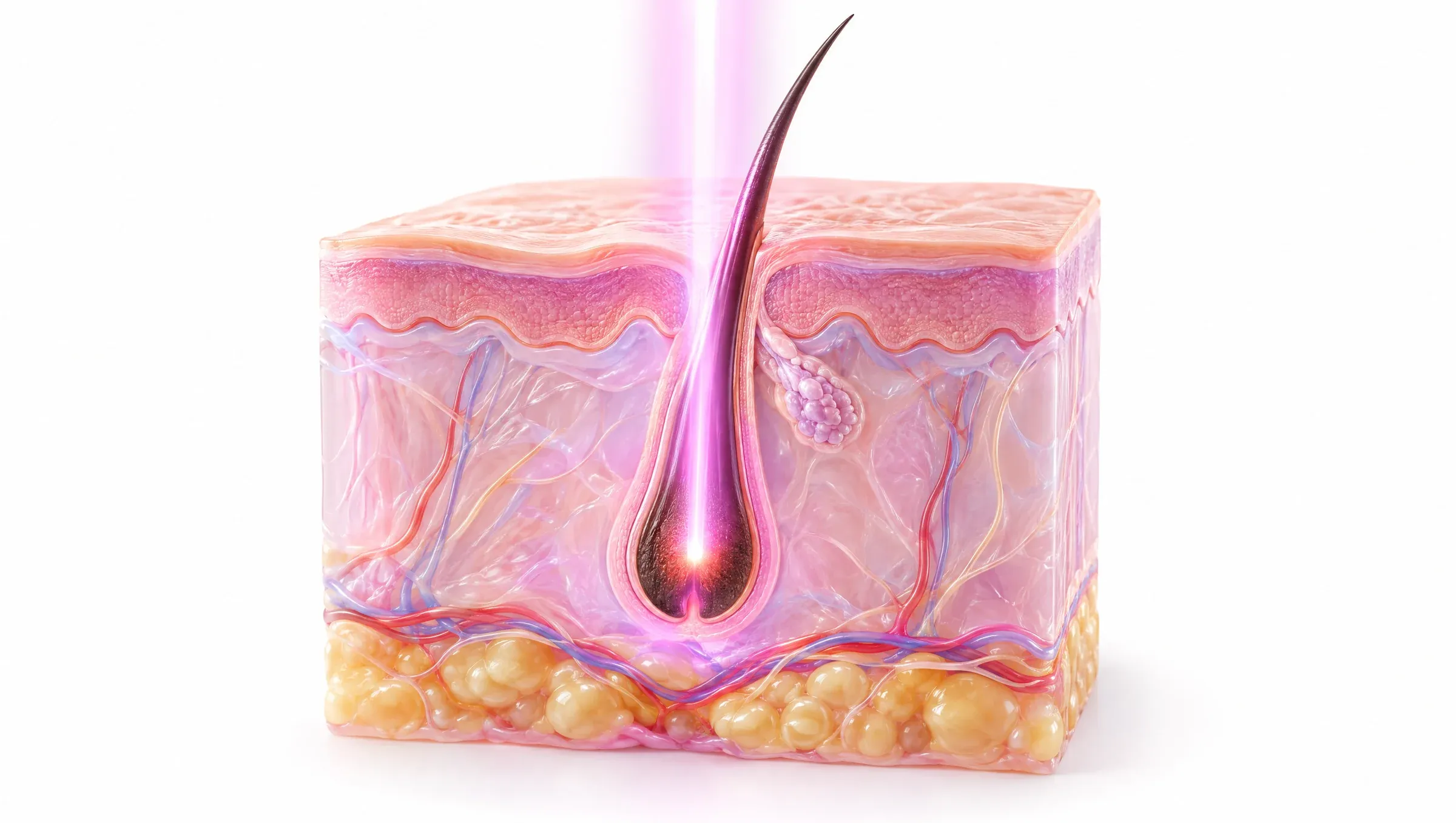
- Laser light passes through the surface, which is cooled while it works.
- Melanin in the hair root absorbs the energy and heats up.
- The heated follicle is disabled, so hair grows back finer, slower and sparser.
Why it takes a course of sessions
Each hair follicle goes through its own cycle of growing, transition and rest. The laser can only reach hairs in the growing phase, when the hair is still attached to its pigmented root. Spacing sessions a few weeks apart catches each new wave of growing hairs, which is why results build over a course rather than in one visit.
Two lasers, chosen for your skin
OrnaSkin has two medical-grade hair removal lasers. Both use an in-motion technique: the handpiece glides continuously over the skin instead of firing single, high-energy shots, which spreads the heat more evenly and keeps sessions comfortable.
DEKA
Motus AX
Alexandrite laser · 755 nm
A sapphire-cooled tip glides over the skin in DEKA’s “Moveo” in-motion technique, building heat in the follicle gradually instead of in single hot shots.
Often chosen for
- Finer or lighter-coloured hair
- Large areas, where the gliding technique saves time
- Lighter to wheatish skin, and many medium skin tones at suitable settings
Alma
Soprano ICE
Diode laser · in-motion
Many rapid, lower-energy pulses raise the follicle’s temperature step by step while a chilled tip keeps the skin surface comfortable.
Often chosen for
- A wide range of Indian skin tones, including deeper wheatish to brown skin
- Coarse, dark hair on the beard area, underarms and legs
- Sensitive areas, thanks to the contact cooling
Neither laser is simply “better”. The right choice depends on your skin tone, your hair colour and thickness, and the area being treated. Sometimes we use both on different areas of the same person. Your dermatologist explains the choice at the consultation and usually tests a small patch first.
Who it suits
Laser hair removal works best when there is contrast between dark hair and the surrounding skin, but modern lasers and careful settings make it suitable for most Indian skin tones. It is commonly chosen by:
- Women with facial hair on the upper lip, chin, jawline and sides of the face, or with unwanted hair on the underarms, arms, legs and bikini area.
- People with PCOS or other hormonal causes of excess hair. Laser reduces the hair you already have, while the hormonal cause is assessed and treated alongside, so new hair growth is kept in check. Expect more sessions and regular maintenance.
- Men who want a cleaner beard line on the cheeks and neck, relief from razor bumps and ingrown hairs, or less hair on the back, chest and shoulders.
- Brides and grooms, as part of a skin plan that starts several months before the wedding.
It is less effective for grey, white, red or very fair hair, which has too little pigment for the laser to target.
Plan your sessions
- Typical course
- 6–10 sessions
- Spacing
- every 4–6 weeks
- Course spans
- about 5–12 months
Facial hair is often hormone-driven, so it usually needs the most sessions and occasional top-ups.
- Typical course
- 6–8 sessions
- Spacing
- every 4–6 weeks
- Course spans
- about 5–10 months
Coarse, dark hair here typically responds well and early.
- Typical course
- 6–8 sessions
- Spacing
- every 6–8 weeks
- Course spans
- about 7–13 months
Large areas are quick with in-motion lasers; regrowth slows visibly after the first few sessions.
- Typical course
- 6–8 sessions
- Spacing
- every 6–10 weeks
- Course spans
- about 7–16 months
Common for men. Hair on the back has a longer cycle, so sessions are spaced further apart.
A guide only. Your dermatologist sets the plan after seeing your skin and hair; hormonal conditions such as PCOS usually mean more sessions and maintenance.
Before, during and after a session
Before
- Shave the area the day before your session. Avoid waxing, threading and plucking for four to six weeks.
- Avoid sun tanning for about two weeks. Arrive without make-up, deodorant or creams on the area.
- Tell us about medicines you take, recent isotretinoin, pregnancy, a tendency to cold sores, or any history of keloids or pigment problems.
During
The area is cleaned and marked, and everyone in the room wears protective eyewear. The laser glides over the skin while its tip cools the surface. Small areas such as the upper lip take a few minutes; a full body takes considerably longer.
After
Mild redness and small bumps around the hair openings are normal and usually settle within a few hours. Use sunscreen on treated areas, and avoid hot baths, steam, saunas and heavy workouts for a day. Treated hairs shed over one to three weeks; this is the laser working, not regrowth.
Laser or waxing?
Waxing removes hair from the root but leaves the follicle working, so hair is back within weeks. Laser reduces the follicle’s ability to regrow, so over time there is simply less hair to deal with.
| Compared | Laser hair removal | Waxing and threading |
|---|---|---|
| Effect on regrowth | Long-term reduction after a course | Regrows within 2–6 weeks |
| Comfort | Cooled, in-motion; a warm flicker | Painful pulling, repeated for life |
| Ingrown hairs and bumps | Usually fewer over time | Common with repeated waxing |
| Marks on the skin | Low risk when settings suit your skin | Repeated waxing can darken skin |
| Long-term cost | Course plus occasional maintenance | Repeated cost every few weeks |
Risks and how we minimise them
Laser hair removal is a medical procedure, and side effects are possible even with careful technique. Most are mild and short-lived:
- Redness, swelling and tenderness for a few hours to a day.
- Temporary darkening or lightening of the skin, more likely after a recent tan. It usually fades over weeks.
- Burns or blisters, which are uncommon and are prevented by matching energy to skin type, cooling, and avoiding treatment on tanned skin.
- Paradoxical hair growth, a rare increase in fine hair near treated areas, reported mostly on the face and neck in darker skin types. It is treated with further laser sessions.
We minimise these risks by having a dermatologist assess your skin and hair before the first session, choosing between two lasers rather than using one machine for everyone, starting with a test patch, and adjusting settings as your hair thins. If anything unusual happens after a session, you can reach us on WhatsApp.