
How dermal fillers work
With age, the face loses volume: fat pads shrink and slip, bone slowly remodels, and the skin holds less moisture. Hollows appear under the eyes and in the cheeks, and folds deepen around the mouth. Hyaluronic acid (HA), a sugar molecule the skin makes itself, can be made into a smooth gel that is injected to replace some of that volume and support the skin from beneath.
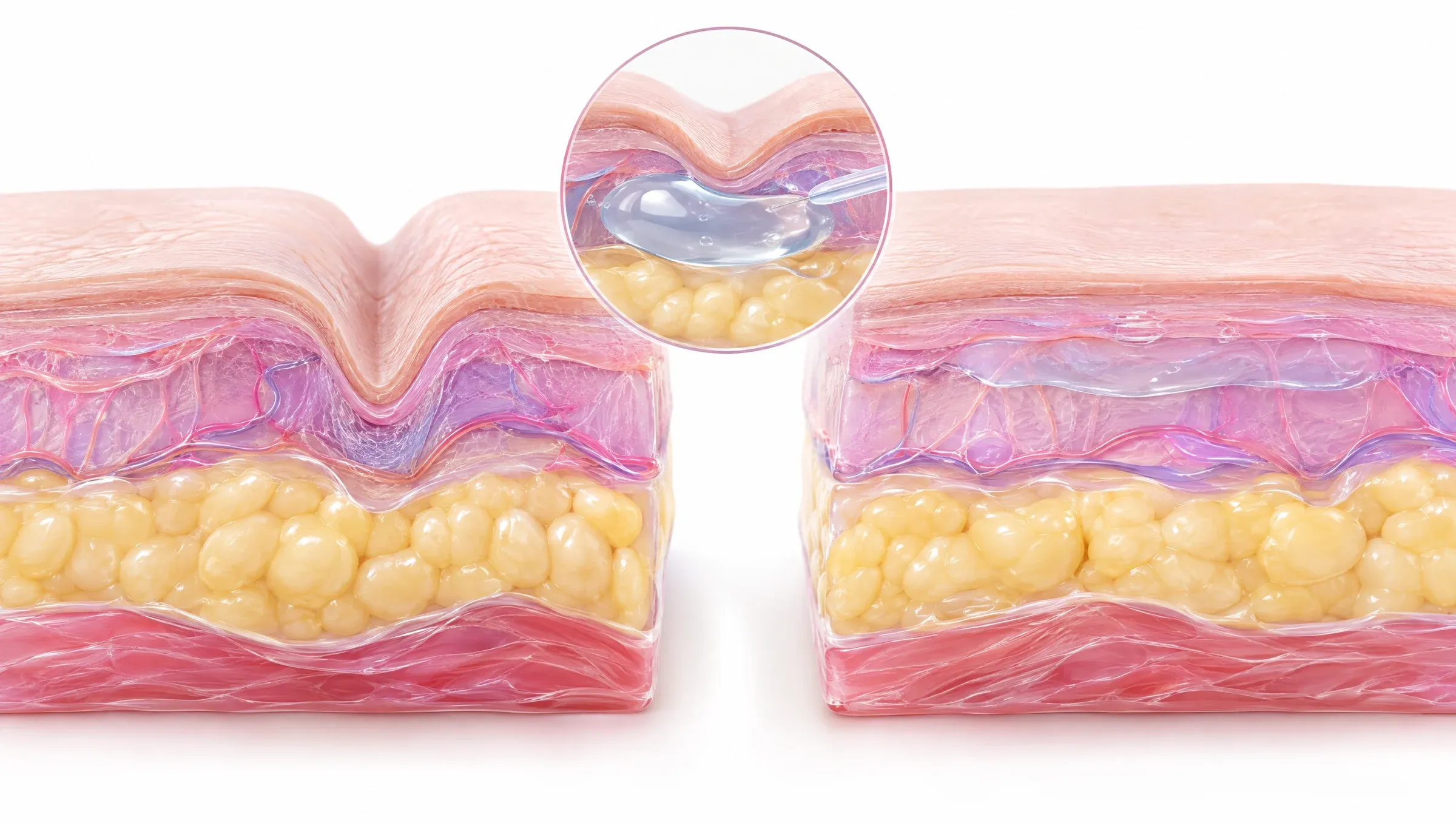
- A hyaluronic acid gel is placed beneath a fold or hollow.
- It restores support where volume has been lost.
- The surface above looks softer; the body gradually absorbs the gel over months.
Fillers come in different thicknesses. Firmer gels give structure on the cheekbones, chin and jawline; softer gels suit lips and fine areas; the softest are used under the eyes. We use genuine, licensed hyaluronic acid fillers and record the product and batch in your file.
Under-eye hollows
- What it treats
- A hollow groove under the eye (tear trough) that casts a shadow and makes you look tired even after a good night’s sleep.
- Typical product
- A soft, low-swelling gel in very small amounts, often placed with a blunt cannula.
- Good to know
- Not right for puffy bags or pigment-type dark circles. The dermatologist checks which you have first.
Cheeks
- What it treats
- Flattened or hollow cheeks from age-related volume loss.
- Typical product
- A firmer gel placed deep, close to the cheekbone, to restore support.
- Good to know
- Restoring the cheek often softens under-eye hollows and smile lines too, so it is usually the first step.
Smile lines
- What it treats
- Deep folds running from the nose to the corners of the mouth (nasolabial folds).
- Typical product
- A medium gel along the fold, often after the cheeks have been supported.
- Good to know
- Some fold is natural and keeps a smile looking real; we soften it rather than erase it.
Lips
- What it treats
- Thin or uneven lips, a soft lip border, and fine vertical lines above the lip.
- Typical product
- A soft, flexible gel, often half to one syringe for a natural result.
- Good to know
- Swelling peaks over the first two days, so judge the result at two weeks. Tell us if you get cold sores.
Chin & jawline
- What it treats
- A receding or short chin, and a jawline that has lost definition.
- Typical product
- A firm, structural gel placed deep on the bone.
- Good to know
- Often improves the side profile. A heavy or sagging jowl may need lifting treatments as well, such as HIFU.
Illustration. The glow shows where volume is usually restored and the dots typical entry points; your dermatologist plans the product, amount and technique for your face.
What it can help with
- Under-eye hollows (tear troughs) that make you look tired.
- Flat or hollow cheeks from volume loss.
- Smile lines (nasolabial folds) and marionette lines.
- Lips: shape, definition, volume and fine lip lines.
- Chin and jawline definition and profile balance.
Lines that come from muscle movement, such as frown and forehead lines, respond better to Botox. For overall dryness, crêpiness and glow rather than shape, skin boosters are a gentler choice.
What results to expect
Straight away
Volume is visible at once, with some swelling and tenderness.
Days 1–3
Swelling and any bruising peak, then settle. Lips swell the most.
About 2 weeks
The gel softens and integrates. Review visit; a small top-up if needed.
6–18 months
Gradual fading as the gel breaks down, depending on area and product.
Results vary with the area, the product, your metabolism and how much volume has been lost. A natural result sometimes needs two smaller sessions rather than one large one.
Who it suits
Adults with hollows, flattened areas or deep folds who want a natural, gradual-looking refresh without surgery, and people who want subtle shaping of the lips, chin or jawline. It suits all skin tones.
Fillers are not given during pregnancy or breastfeeding, over active acne, cold sores or infection in the area, during a flare of an autoimmune condition, or if you have had a reaction to hyaluronic acid or lidocaine. Tell us about blood thinners, permanent fillers or threads you have had before, recent dental work and upcoming events.
Before, during and after
Before
At the consultation, the dermatologist looks at your face from the front and side, at rest and smiling, and explains which areas would make the most difference and which would not. If you can, avoid aspirin, other blood-thinning painkillers, fish-oil supplements and alcohol for a few days before, to reduce bruising; don’t stop any prescribed medicine without asking your doctor. Plan fillers at least two weeks before an important event.
During
The skin is cleaned thoroughly and numbing cream applied if needed. The gel is placed slowly with a fine needle or a blunt cannula, and the area is shaped gently. You can check the result in a mirror as we go. Most treatments take about 30–45 minutes, including numbing.
After
- Expect some swelling, tenderness and possibly a bruise for a few days; a cold pack helps.
- Avoid make-up on the area for 12 hours, and heavy exercise, saunas and steam for a day or two.
- Don’t massage or press on the area unless you are asked to.
- Contact the clinic straight away if you notice severe or increasing pain, skin that turns pale, dusky or blotchy, or any change in vision.
Risks and how we minimise them
Most side effects are mild and temporary: swelling, tenderness, redness, bruising, and sometimes small lumps that settle or can be massaged out. Less often, the result is uneven or a bluish tinge shows under thin skin; both can be corrected, including by dissolving the filler.
The rare but serious risk is filler entering or pressing on a blood vessel, which can harm the skin above it and, very rarely, affect vision. We minimise this by knowing the danger zones of the face, injecting slowly in small amounts, using blunt cannulas where suitable, choosing the right product for each layer, and watching the skin throughout. Hyaluronidase, the enzyme that dissolves filler, is kept at the clinic for emergencies.