
How anti-wrinkle injections work
Many lines on the upper face are expression lines: they form where a muscle repeatedly folds the skin above it, such as when you frown, raise your brows or smile with your eyes. Botulinum toxin, best known by the brand name Botox, temporarily blocks the nerve signal that tells a muscle to contract. The treated muscle relaxes, so the skin above it creases less and the line softens.
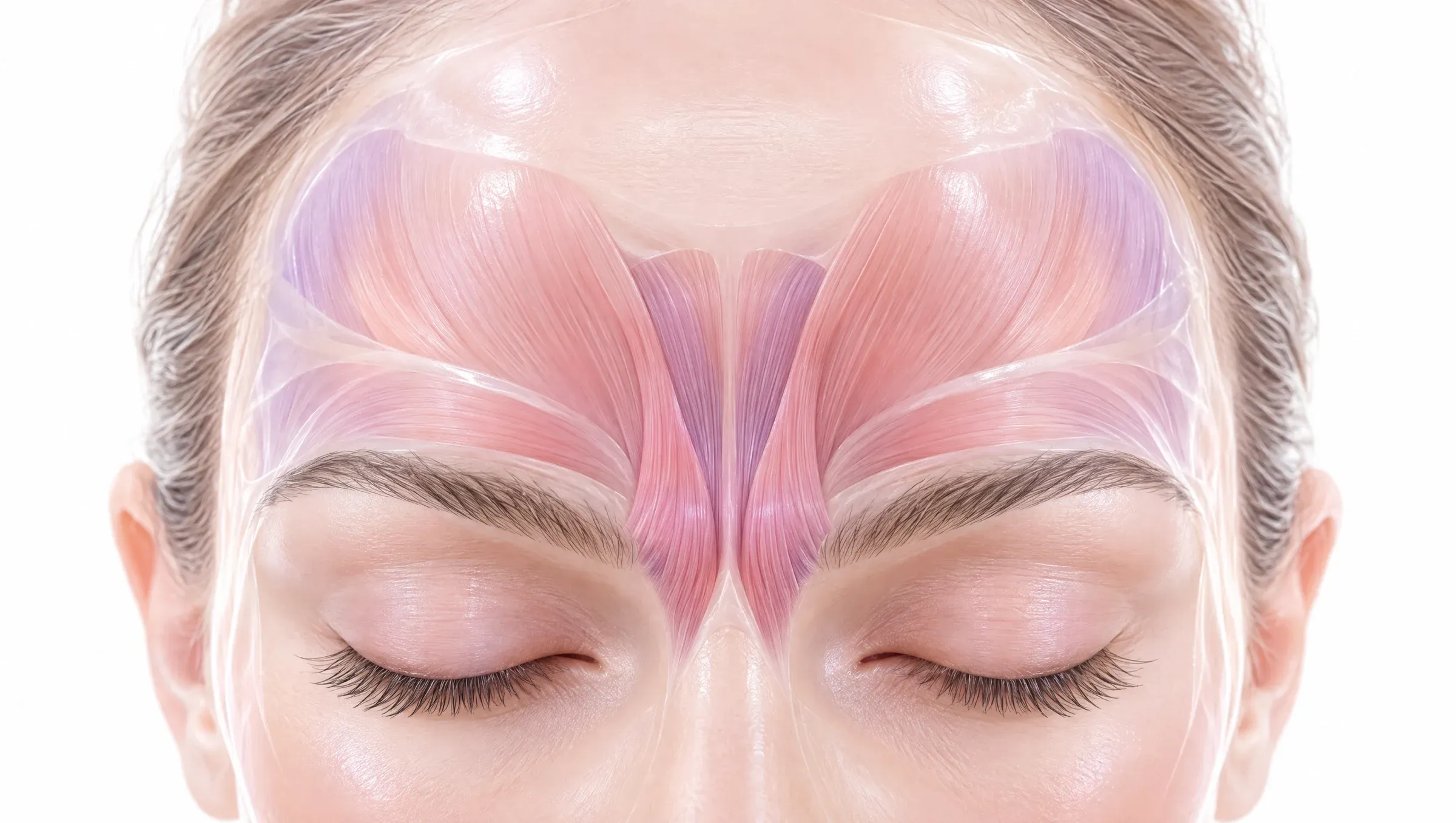
- A tiny dose is placed into the muscle that folds the skin.
- It blocks the nerve signal, so that muscle relaxes over a few days.
- The line above softens; the effect wears off gradually over months.
The effect is local and temporary. Only the small muscles that are injected relax; the rest of your face moves normally, and the nerve signal recovers over three to four months. We use a genuine, licensed botulinum toxin product, and the doses are recorded in your file.
Frown lines (11s)
- What they are
- Vertical lines between the brows that deepen when you concentrate, squint or frown, and can make you look cross or tired.
- Muscles
- The corrugators, which pull the brows together, and the procerus at the top of the nose.
- Good to know
- The most studied use of botulinum toxin. Deep lines that stay at rest may also need a filler or skin booster to fill the crease.
Forehead lines
- What they are
- Horizontal lines across the forehead from raising your brows, often when talking or with heavy lids.
- Muscle
- The frontalis, the only muscle that lifts the brows.
- Good to know
- Dosed lightly and usually treated together with frown lines for balance, so the brows don’t feel heavy or drop.
Crow’s feet
- What they are
- Fan-shaped smile lines at the outer corners of the eyes.
- Muscle
- The outer part of the orbicularis oculi, the ring muscle that closes the eye.
- Good to know
- Injections stay outside the bony eye socket. Lines under the eye from thin, crêpey skin respond better to skin boosters or lasers.
Bunny lines
- What they are
- Diagonal lines on the sides of the nose when you scrunch it or smile broadly.
- Muscle
- The nasalis, across the upper nose.
- Good to know
- A tiny dose is enough. They often show up once frown lines are treated, so they are usually planned together.
Brow lift
- What it does
- Lifts the tail of the brows by a few millimetres for a more open, rested look.
- How
- Relaxing the small muscle fibres that pull the brow tail down lets the forehead muscle lift it a little.
- Good to know
- A subtle change, not a surgical lift. Heavy, hooded lids need a different plan.
Illustration. Dots show typical injection points; your dermatologist plans the exact points and doses for your muscles. Lines soften gradually over about two weeks.
What it can help with
- Frown lines (the “11s”) between the brows.
- Forehead lines from raising the brows.
- Crow’s feet at the outer corners of the eyes.
- Bunny lines on the sides of the nose.
- A gentle brow lift at the tail of the brows.
Lines that are etched into the skin even when your face is still, and hollows or folds such as tear troughs and smile lines, are caused by lost volume rather than muscle movement. These respond better to dermal fillers or skin boosters, often alongside a little Botox. Botulinum toxin is also used for excessive underarm sweating and for a slimmer jawline; ask at your consultation whether these suit you.
What results to expect
Same day
Tiny bumps at the injection points settle within about 20 minutes. Go back to your day.
Days 3–5
Movement starts to soften and lines look smoother.
About 2 weeks
Full effect. A review visit lets us add a small top-up if one side moves more.
3–4 months
Movement returns gradually. Repeat when you wish; there is no need to keep going.
Results vary with your muscles, skin thickness and how deep the lines are. Lines that remain at rest soften more slowly and may need a combined plan.
Who it suits
Adults who are bothered by lines that appear with expression, from people in their late twenties with strong frown lines to people in their fifties and beyond who want a fresher, more rested look. It suits all skin tones, because it acts on muscle, not pigment.
It is not given during pregnancy or breastfeeding, to people with a neuromuscular condition such as myasthenia gravis, over an infection at the injection site, or if you have had an allergic reaction to a botulinum toxin product. Tell us about all your medicines, any recent treatments on your face and any important events coming up, so we can time it well.
Before, during and after
Before
At the consultation, the dermatologist watches your face at rest and in motion, discusses what bothers you and what you want to keep, and agrees the areas and doses with you. If you can, avoid painkillers that thin the blood, such as aspirin, and alcohol for a day or two before, to reduce bruising; don’t stop any prescribed medicine without asking your doctor. Plan treatment at least two weeks before an event.
During
The skin is cleaned and the points are marked. A very fine needle places tiny amounts of product into each point. It feels like quick pinpricks, and the injections themselves take about five to ten minutes.
After
- Stay upright for about four hours and don’t rub, massage or press on the treated areas that day.
- Skip heavy exercise, saunas, steam and facials for 24 hours.
- Light make-up and normal skincare are fine after a few hours.
- Come back at about two weeks for a review, especially after your first treatment.
Risks and how we minimise them
Side effects are usually mild and short-lived: small bumps, slight redness, a tiny bruise at an injection point or a mild headache for a day or two. Less commonly, the product affects a nearby muscle, which can cause a heavy brow, an uneven or raised brow, or a slightly drooping eyelid for a few weeks until it wears off. These are rare when the dose and placement are planned carefully.
We reduce these risks by assessing how your muscles move before choosing doses, placing injections away from the eye socket, starting conservatively with a review at two weeks, and using a genuine product that is stored and prepared correctly. Very rarely, people develop resistance after many treatments, which is why we avoid unnecessary top-ups.