
OrnaSkin Madhur NagarBy appointment · Monday–Saturday, 10 am – 7:30 pm

Book a consultation

Acne & scars

Acne scar treatment
in Rajkot

Acne scar treatment works by remodelling the skin beneath the scars. At OrnaSkin the method is matched to the scar type: fractional CO2 laser to resurface, microneedling radiofrequency (MNRF), RF subcision for tethered rolling scars, and PRP to support healing. Most plans combine methods over several sessions. Scars soften and become shallower rather than disappear.

How acne scars form

When a pimple is deep or badly inflamed, the inflammation damages the collagen that supports the skin from below. As the skin heals, it does not always rebuild that support evenly. Where too little collagen forms, the surface sinks into a dip or pit: these are atrophic scars, the most common kind after acne. Less often, too much collagen forms and the scar is raised, which is treated differently.

Scars are not the same as acne marks. Marks are flat patches of brown, red or purple colour left after a pimple heals, and they usually fade with sun protection and the right creams. Scars change the texture of the skin, so they need treatments that rebuild collagen. Many people have both, and a good plan treats both.

Three kinds of scar, three approaches

Rolling

Soft, wave-like dips, pulled down by fibrous bands under the skin.

  • RF subcision
  • MNRF
  • Fractional CO2

Boxcar

Broad depressions with sharp, steep edges, like a small crater.

  • Fractional CO2
  • Erbium glass
  • MNRF

Ice-pick

Narrow, deep pits that look like large open pores.

  • Fractional CO2
  • Planned case by case
Most people have a mix of types, which is why scar plans usually combine methods. Dotted lines show the fibrous bands that tether rolling scars.

Telling these types apart is the first step, because each responds to a different method. In the consultation room, the dermatologist examines your skin under angled light, notes which types you have and where, and checks for active acne, marks and your skin’s tendency to darken after injury.

The treatments we use

Acne scar treatment works by controlled injury: creating tiny, precise zones of damage that the skin repairs with new collagen. Each method does this at a different depth and with a different recovery.
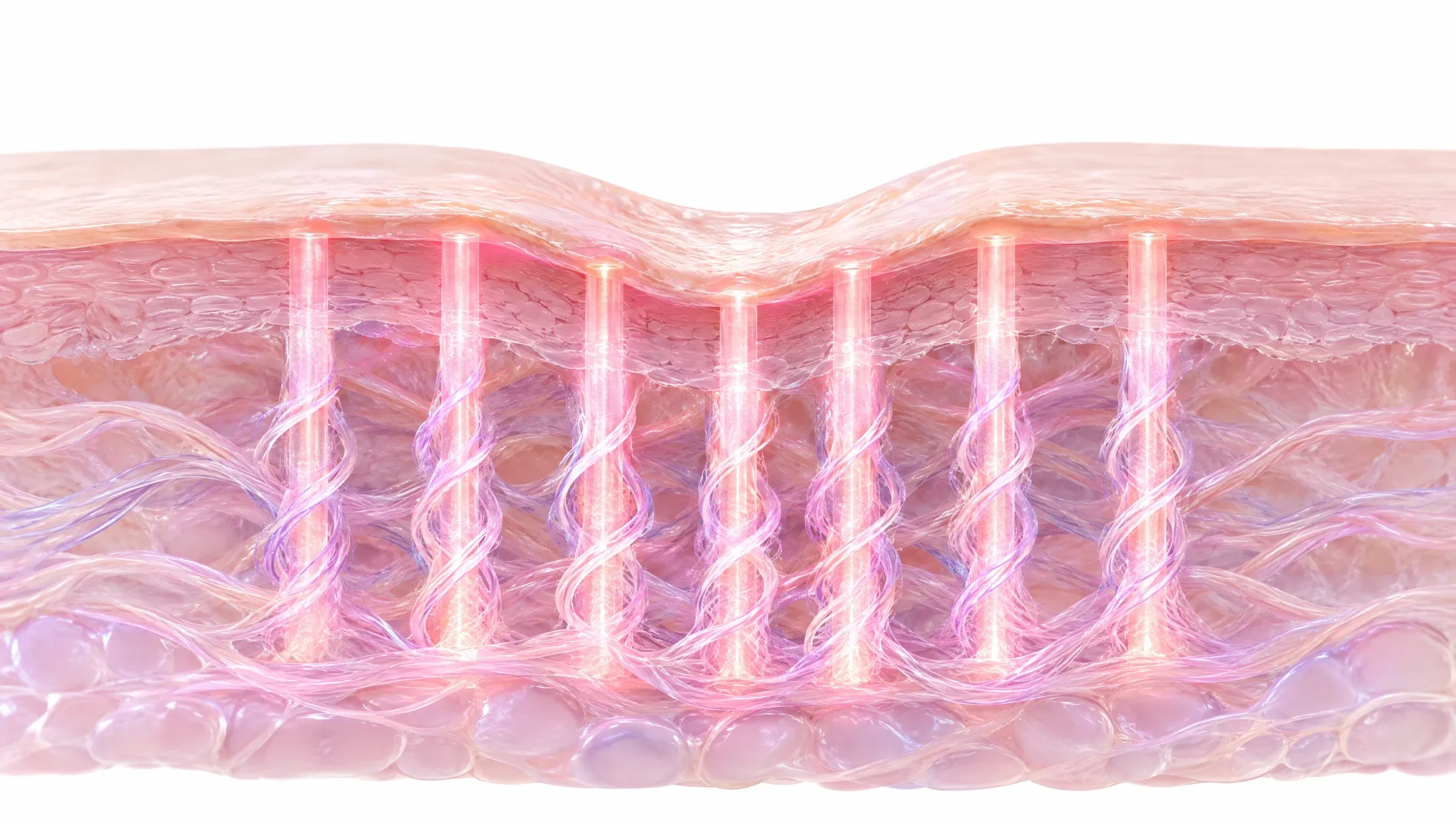
Illustration: a row of microscopic columns reaching into the dermis, with new collagen forming around them beneath a shallow scar.
Illustration
  1. Laser or fine needles make microscopic channels, leaving the skin between them intact.
  2. The skin repairs each channel and lays down new collagen.
  3. Over months the new collagen helps lift and soften depressed scars.
  • Fractional CO2 laser (FRx). The Dolphin fractional CO2 laser makes thousands of microscopic columns through the surface into the dermis. The skin heals from the untouched skin around each column, resurfacing the edges of scars and tightening the base. It tends to give a noticeable change per session, in return for a few days of recovery.
  • Microneedling radiofrequency (MNRF). Fine insulated needles on the Intensif probe of our EndyMed PURE deliver radiofrequency heat beneath the surface, remodelling collagen deeper with less effect on the top layer. It suits people who cannot take much downtime and is often combined with laser.
  • RF subcision. For rolling scars, a fine probe releases the fibrous bands that pull the skin down, so the scar can lift. Laser and MNRF then smooth the surface.
  • Fractional erbium glass laser (1550 nm). A non-ablative laser that heats columns of skin without breaking the surface. Recovery is usually a day or two of redness, and it helps with texture and shallow scars.
  • PRP (platelet-rich plasma). Concentrated platelets from your own blood are applied or injected after laser or MNRF to support healing. Our plans combine it with FRx where it helps.

Most people need a combination. A typical plan might begin with RF subcision for rolling scars, followed by a course of fractional laser or MNRF sessions a few weeks apart, with PRP added to some of them.

Who it suits

Acne scar treatment suits adults and older teenagers whose acne is under control and who have scars that bother them. It works on all Indian skin types when the settings and preparation are right. It is not started while acne is active, during pregnancy, over skin infections or cold sores, or if you tend to form raised (keloid) scars, which need a different approach.

Before, during and after

Before

  • Get active acne under control first; your dermatologist may treat both together.
  • Avoid sun tanning for two weeks. You may be given creams to prepare the skin and lower the risk of darkening.
  • Tell us about recent isotretinoin, a history of cold sores, keloids or pigment problems, and any medicines you take.

During

A numbing cream is applied for about 45 minutes. The treatment itself usually takes 15 to 30 minutes for the face. With laser you feel heat and prickling; with MNRF, a series of warm pricks. Cooling is used throughout.

After

  • Fractional CO2: redness, swelling and a fine sandpaper-like crust for about three to seven days. Do not pick; the crust protects new skin.
  • MNRF and erbium glass: redness for a day or two, sometimes small grid marks that fade quickly.
  • RF subcision: swelling and bruising for several days.
  • Use the soothing cream and sunscreen you are given, avoid the sun, and skip make-up until the skin has settled. We review you before the next session.

What results to expect

Collagen takes months to remodel, so improvement continues for three to six months after each session. Scars become shallower, their edges soften, and the skin looks smoother in daylight. Results vary with scar type, depth, skin type and how many sessions you have; deep or widespread scarring improves but rarely disappears completely. Photographs taken at your first visit help you see the change.

How we photograph progress and share results, only with written consent, is explained on our results page.

Risks and how we minimise them

  • Temporary darkening (post-inflammatory hyperpigmentation) is the most common concern on Indian skin. We lower it with conservative settings, preparing the skin where needed, and strict sun protection, and treat it promptly if it appears.
  • Prolonged redness can last a few weeks after laser in sensitive skin.
  • Infection or a cold sore flare is uncommon; preventive medicine may be given if you are prone to cold sores.
  • Grid marks, bruising or swelling settle with time.

Choosing the right method for each scar type, and spacing sessions so the skin fully recovers, matters as much as the machine.

The technology we use.

  • Dolphin

    Fractional CO2

    Ablative fractional laser

    10,600 nm

  • EndyMed

    EndyMed PURE

    3DEEP radiofrequency

    Face-tightening probe + Intensif MNRF probe

  •  

    RF subcision

    Radiofrequency-assisted subcision

    Releases tethered scars

  •  

    Erbium glass laser

    Non-ablative fractional laser

    1550 nm

What does acne scar treatment cost in Rajkot?

Acne scar sessions typically cost about ₹5,500–20,000, depending on the area and whether PRP or an advanced protocol is added. A 7-session course usually costs ₹28,000 to about ₹1 lakh as a package. Your exact plan and price are set at the consultation, after the dermatologist has examined you.

Per session

₹5,500–₹20,000

a session

Course / package

₹28,000–₹1,00,000

for a 7-session package

What changes the price

  • Scar type and depth
  • The area: face, neck or back
  • Combining treatments, e.g. laser with PRP
  • The number of sessions (packages cost less per session)

Indicative ranges from our current rate card, in Indian rupees, taxes as applicable. They are a guide, not a quote.

Ask about your plan

Your dermatologist

Dr. Smit Thakkar

MBBS, DDVL · Consultant dermatologist · leads OrnaSkin

At our Madhur Nagar skin clinic you are seen by Dr. Smit Thakkar himself, who examines your skin, explains your options plainly and plans the treatment with you.

About Dr. Smit Thakkar

Questions about acne scar treatment

Can acne scars be removed completely?

Usually not completely, and anyone who promises that is overselling. What treatment does well is make scars shallower, softer at the edges and less noticeable in normal light. Most people see a clear improvement over a course, and the change keeps building for months as new collagen forms.

What is the difference between acne marks and acne scars?

Marks are flat brown, red or purple spots left after a pimple heals. They are colour, not texture, and usually fade with sun protection, creams, peels or toning. Scars are changes in the skin's surface, such as dips and pits, and need treatments that rebuild collagen.

Which treatment is best for my scars?

It depends on your scar types, skin tone and how much downtime you can take. Rolling scars often need RF subcision to release them, boxcar scars respond to fractional laser or MNRF, and ice-pick scars need focused treatment. Most plans combine two or three methods, decided after the dermatologist examines your skin.

How many sessions will I need?

Most people need a course of several sessions spaced four to six weeks apart, and our laser plans are usually a course of seven. Mild scarring needs fewer; deep or widespread scarring more. Your dermatologist estimates this at the first visit.

Is fractional CO2 laser safe for Indian skin?

Yes, with the right settings and preparation. The main risk on Indian skin is temporary darkening after treatment. We reduce it by choosing the energy and density for your skin type, sometimes preparing the skin with creams beforehand, and insisting on strict sun protection afterwards.

How much downtime is there?

After fractional CO2, expect redness and fine crusting for roughly three to seven days. MNRF and erbium glass usually mean one or two days of redness. RF subcision can cause swelling and bruising for several days. We plan sessions around your work and events.

My acne is still active. Can I start scar treatment?

Active acne is treated first, because new breakouts create new scars and inflamed skin heals less predictably. Some gentle scar treatments can start once acne is largely controlled. If you have recently taken isotretinoin, the dermatologist will discuss the right timing with you.

How much does acne scar treatment cost in Rajkot?

At OrnaSkin, a fractional CO2 laser session for acne scars typically costs about ₹5,500–20,000, depending on the area and whether PRP or an advanced protocol is added. A 7-session course usually costs ₹28,000 to about ₹1 lakh as a package. The cost of MNRF or subcision depends on the area and the number of scars. Your exact plan, and its cost, is set at the consultation.

Further reading

References

  1. Acne scarring: a classification system and review of treatment options. Jacob CI, Dover JS, Kaminer MS. Journal of the American Academy of Dermatology, 2001;45(1):109–117
  2. Acne scars: pathogenesis, classification and treatment. Fabbrocini G, Annunziata MC, D'Arco V et al. Dermatology Research and Practice, 2010
  3. Acne scarring: pathogenesis, evaluation, and treatment options. Connolly D, Vu HL, Mariwalla K, Saedi N. Journal of Clinical and Aesthetic Dermatology, 2017;10(9):12–23

This page explains a treatment in general terms and is not a diagnosis or a promise of results. Results vary from person to person. A dermatologist decides what is right for you after examining your skin. Read our medical disclaimer and editorial policy.

By appointment Dr. Smit Thakkar

Talk to a dermatologist about acne scar treatment.

Book a consultation at OrnaSkin Madhur Nagar. Tell us what you would like to change and we will plan it with you.

Your bag

Your bag is empty.

Browse Orna Skincare