Before a first laser session, most of the questions we hear in Rajkot are not about the hair at all. They are about what people have heard from a cousin, a salon or a forwarded message: that laser causes cancer, that it can affect having children, that hair comes back thicker, or that it is “permanent” after six sittings. Some of these are myths. Others contain a grain of truth. Here is how they compare with the evidence.
How a hair-removal laser actually works
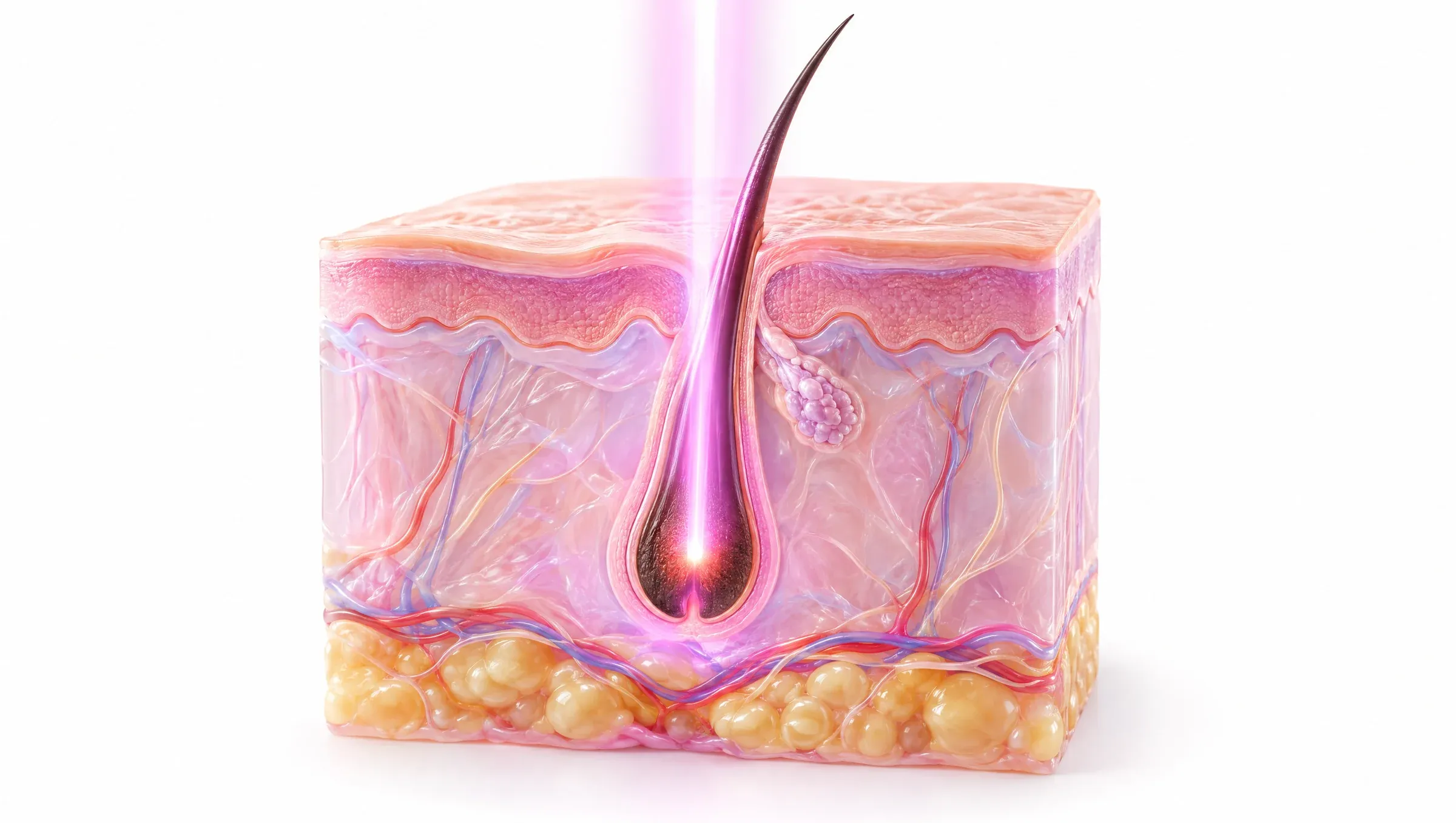
A hair-removal laser sends a pulse of visible or near-infrared light (roughly 755 to 1064 nm on most machines) into the skin. The light is absorbed by melanin, the pigment in the hair shaft and root, and turns into heat. That heat damages the parts of the follicle that make new hair. The effect is local: the energy is used up within a few millimetres of the surface, which is exactly where hair roots sit.
Keep that picture in mind, because it answers most of the myths below.
Myth 1: “Laser causes cancer”
What the evidence says: there is no evidence that hair-removal lasers cause cancer.
The radiation that raises cancer risk is ionising radiation (X-rays, gamma rays) and ultraviolet light from the sun, both of which damage DNA. Hair-removal lasers use non-ionising light at longer wavelengths. It heats; it does not break DNA. Lasers of this kind have been used on skin for more than 25 years, and cancer bodies such as Cancer Council Australia advise that laser hair removal is fine for people without a history of skin cancer.
The grain of truth: laser can change the colour of a mole, which makes it harder to watch for warning signs later. That is why a dermatologist looks at your moles before the first session, covers or avoids them, and checks any mole that looks unusual first. If you or a close relative have had melanoma, or you have many unusual moles, say so at the consultation.
Myth 2: “Laser on the underarms or bikini line affects fertility”
What the evidence says: it doesn’t. The light is absorbed within millimetres of the skin, by the hair root. It does not reach the ovaries, the uterus or any organ, and it does not change hormone levels.
The grain of truth: doctors usually postpone laser during pregnancy. Not because harm has been shown, but because there is very little research in pregnant women, and an elective treatment can safely wait. Pregnancy hormones also bring new hair that often settles after delivery, so treating it during pregnancy is not good value anyway.
Myth 3: “Hair grows back thicker after laser”
What the evidence says: for almost everyone, treated hair grows back finer, lighter and slower, and there is less of it with each session.
The grain of truth: a small number of people develop paradoxical hair growth: fine, light hairs next to or within a treated area turn coarser after laser. Published figures range from under 1% to about 10%, and it is more common on the face and neck in women and the back and shoulders in men, and in people with darker skin or hormonal hair. Using energy levels that are high enough for your hair (low “gentle” settings may be part of the cause), protecting the area from sun and reporting new growth early all help; the extra hairs usually respond to further treatment.
The related myth that shaving makes hair thicker is simply wrong: a study measuring hair before and after repeated shaving found no change in thickness or growth rate. Shaving only cuts the hair at a blunt angle, so regrowth feels coarser.
Myth 4: “Six sittings and it’s permanent”
What the evidence says: laser gives a long-term reduction in the number of hairs that grow back, which is how regulators describe it (“permanent hair reduction” means a stable reduction that lasts beyond a full hair-growth cycle, not that every hair is gone).
In practice:
- Most areas need six to ten sessions, four to eight weeks apart, because the laser only works on hairs in their growing phase.
- Many people keep much less hair for years, and what grows back is finer.
- Some regrowth is common, especially with hormonal hair (PCOS), after pregnancy, or with age, so occasional maintenance sessions are normal. Read our guide to laser for PCOS facial hair.
- Very light, grey, red or white hair has little pigment for the laser to target and responds poorly.
Anyone who promises 100% permanent removal after a fixed number of sittings is promising more than laser can deliver.
Myth 5: “Laser isn’t for dark skin”
What the evidence says: it is, with the right equipment and settings. Skin pigment also absorbs laser light, so darker skin has a higher risk of burns and dark or light patches if the wavelength or energy is wrong. Longer wavelengths, good cooling and careful settings make it safe for most Indian skin types. That’s why a dermatologist chooses the laser and settings for your skin; we explain how in laser hair removal on Indian skin.
The side effects that are real
Laser hair removal is low-risk when it is planned by a dermatologist, but it is not risk-free. What to expect:
| How often | What | How long |
|---|---|---|
| Common | Redness, warmth, small bumps around the hairs | A few hours to a day |
| Occasional | Temporary darkening or lightening of the skin, more likely after sun or a recent tan | Weeks to months, usually fades |
| Occasional | Acne-like spots or itching in treated areas | Days |
| Rare | Blisters or burns, usually from settings that were too strong for the skin or a tan | Heal over weeks; can leave marks |
| Rare | Paradoxical hair growth (see above) | Treated with further sessions |
| Rare | Eye injury if eyes aren’t protected | Prevented by proper eye shields |
Most of these are avoidable: no tanning for two weeks before a session, shave, don’t wax or thread, tell us about new medicines (some make skin sun-sensitive), and use sunscreen afterwards. Our before and aftercare guide has the full list.
The short version
Laser hair removal doesn’t cause cancer and doesn’t affect fertility. Hair usually comes back finer, not thicker, and the result is a long-term reduction with occasional top-ups, not a guaranteed zero. The real risks sit in the skin, and they depend mostly on the laser, the settings and the preparation. For how a course is planned, the two lasers we use and what it costs, see our laser hair removal page.