
If you have looked into hair fall treatment in Rajkot, you have probably been offered at least one of three names: PRP, GFC and exosomes. They are often sold as if each were a newer, stronger version of the last. The reality is more useful to know: they are different tools, with very different amounts of evidence behind them, and all three work best on top of the basics.
First: what kind of hair fall is it?
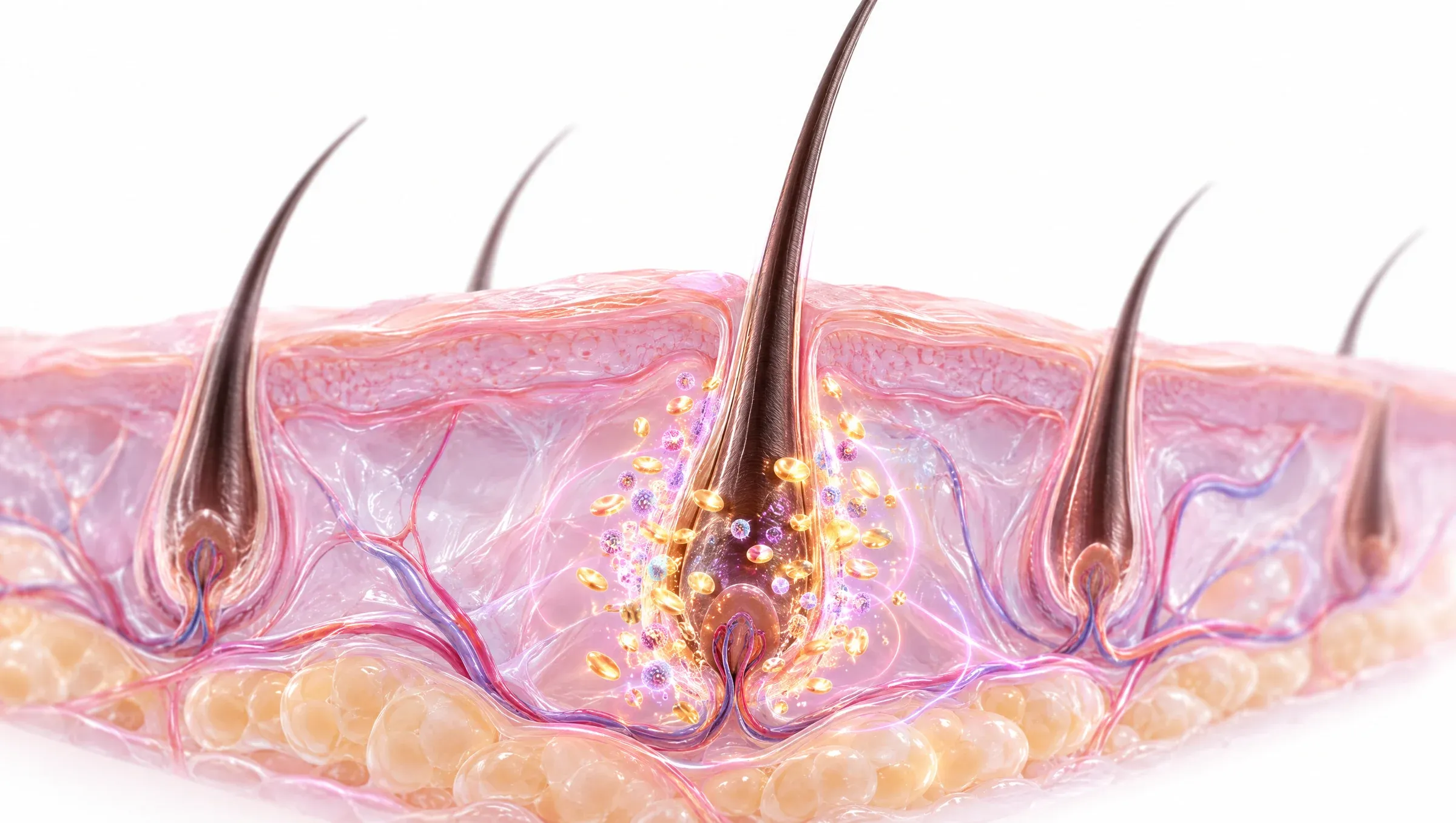
These treatments are mainly used for pattern hair loss (androgenetic alopecia): a widening parting in women, a receding hairline or thinning crown in men. In pattern hair loss, follicles slowly shrink and each new hair grows back thinner.
They are not the first answer for shedding caused by low iron or vitamin D, thyroid problems, a recent fever or illness, crash dieting, or after childbirth. That kind of hair fall usually settles once the cause is treated. Patchy bald spots (alopecia areata) need a different treatment altogether. That is why every plan starts with a consultation, a scalp check and, often, blood tests. Our hair fall treatment page explains how we work out the cause.
The three, side by side
| PRP | GFC | Exosomes | |
|---|---|---|---|
| What it is | Platelets concentrated from your own blood | Growth factors released from your own platelets, in the tube | Tiny particles released by cells, from a manufactured product |
| Comes from | You | You | A lab (stem cells or plants, depending on the product) |
| Amount of research | The most of the three: several trials and reviews | Small studies and case series | Mostly lab and animal studies; few human trials |
| How it is given | Injected into thinning areas | Injected into thinning areas | Injected, or applied after microneedling |
| Typical plan | Monthly at first, then maintenance | Similar to PRP | Varies by product |
PRP: the one with the most evidence
Platelet-rich plasma is made by drawing a small amount of your blood, spinning it to concentrate the platelets, and injecting them into the thinning areas of the scalp. Platelets carry growth factors that support blood supply and help follicles stay in their growing phase longer.
PRP is the best studied of the three. An expert consensus review in 2019 concluded that PRP is beneficial for pattern hair loss and suggested starting with three monthly sessions, followed by maintenance every three to six months. Results differ between studies, partly because PRP is prepared in many different ways, and people respond differently. It tends to work best early, while follicles are still alive, and alongside medicines.
At OrnaSkin, PRP is usually given as Meso-PRP, combined with mesotherapy, as a course of at least 10 sessions. See PRP for hair for how a session runs.
GFC: a refinement of PRP
Growth factor concentrate also starts with your own blood. The difference is in the preparation: instead of injecting the platelets, a special kit makes the platelets release their growth factors in the tube, and that growth-factor-rich liquid is injected. The idea is a more consistent, concentrated dose, often with less discomfort.
The idea is sensible, but the evidence is still thin. Most published GFC studies are small case series from India, some with as few as five patients and only a few weeks of follow-up, without a comparison group. GFC may turn out to be as good as or better than PRP, but that has not yet been shown in large, controlled trials.
Exosomes: the newest, and the least proven
Exosomes are microscopic packages that cells release to signal to each other. Products for hair contain exosomes collected from cells grown in a lab, most often stem cells, sometimes plants. In lab and animal research they switch on pathways that push follicles into their growing phase.
A 2025 systematic review found 27 studies on exosomes for hair, but only three were clinical studies in people. Those early results were positive, and the authors called for larger trials before exosomes are widely used. Products also differ a great deal from one maker to another. In the US, the FDA has not approved any exosome product and has warned consumers about clinics selling unapproved ones.
That doesn’t mean exosomes are useless. It means they are an add-on with early evidence, best used through a dermatologist who can tell you exactly which product goes into your scalp and why. At OrnaSkin, exosomes are offered as Exo-Hair (six sessions) and Exo-Meso Hair (with mesotherapy, 10 sessions). Read more in exosome therapy for skin and hair.
None of them replaces the basics
European guidelines on pattern hair loss put medicines first: minoxidil for men and women, and finasteride for suitable men. Injectable treatments sit on top of those, to support weaker follicles; they are not a substitute for them. Treating low iron or thyroid problems, eating enough protein and handling the scalp gently all matter too.
People who stop everything and rely on injections alone are often disappointed. People who combine the right medicine, the right in-clinic treatment and patience usually do better.
Who should choose which?
- Early pattern thinning, wanting the best-studied option: PRP, alongside medicines.
- Already on medicines, wanting extra support: PRP or an exosome course may be added; your dermatologist will explain the trade-offs.
- Diffuse shedding from a recent cause (fever, childbirth, dieting, low iron): treat the cause first. Injections are rarely needed.
- Smooth, bald areas for years: none of these regrows hair there. A hair transplant consultation may be more useful.
PRP and GFC are not given during pregnancy, with blood or platelet disorders, while on blood thinners (unless your doctor agrees), with an active scalp infection, or during cancer treatment.
What results to expect
Hair grows slowly, so nothing changes overnight. With any of these treatments, people usually notice less shedding first, over two to three months, and better density over four to six months. Progress photos taken under the same light at each visit are the fairest way to judge. Results vary, and maintenance is part of every plan because pattern hair loss keeps progressing without it.
The short version
PRP has the strongest evidence, GFC is a promising refinement with small studies, and exosomes are the newest with the least proof. The bigger decision is not which injection, but whether you have the right diagnosis and the right medicines first. For costs and how a plan is built, see our hair fall treatment page.