
OrnaSkin Madhur NagarBy appointment · Monday–Saturday, 10 am – 7:30 pm

Book a consultation

Skin concern

Warts, moles & skin tags

Warts are skin growths caused by a virus, skin tags are soft harmless flaps common on the neck and underarms, and moles are clusters of pigment cells. Most are harmless and can be removed in a quick procedure. A mole that changes in size, shape or colour, bleeds or itches should be checked by a dermatologist first.

In the skin

Three common growths

Illustration, not to scale. Layers from top: outer skin (epidermis), dermis, fat.

Common skin growths

Most small bumps and spots on the skin are harmless. The most common are warts (caused by a virus), skin tags (soft flaps of skin), moles (clusters of pigment cells) and seborrhoeic keratoses (waxy, “stuck-on” growths that appear with age). They are usually removed because they catch on clothing or jewellery, bleed when shaved, spread (warts) or simply bother you. A few, especially changing moles, need checking first.
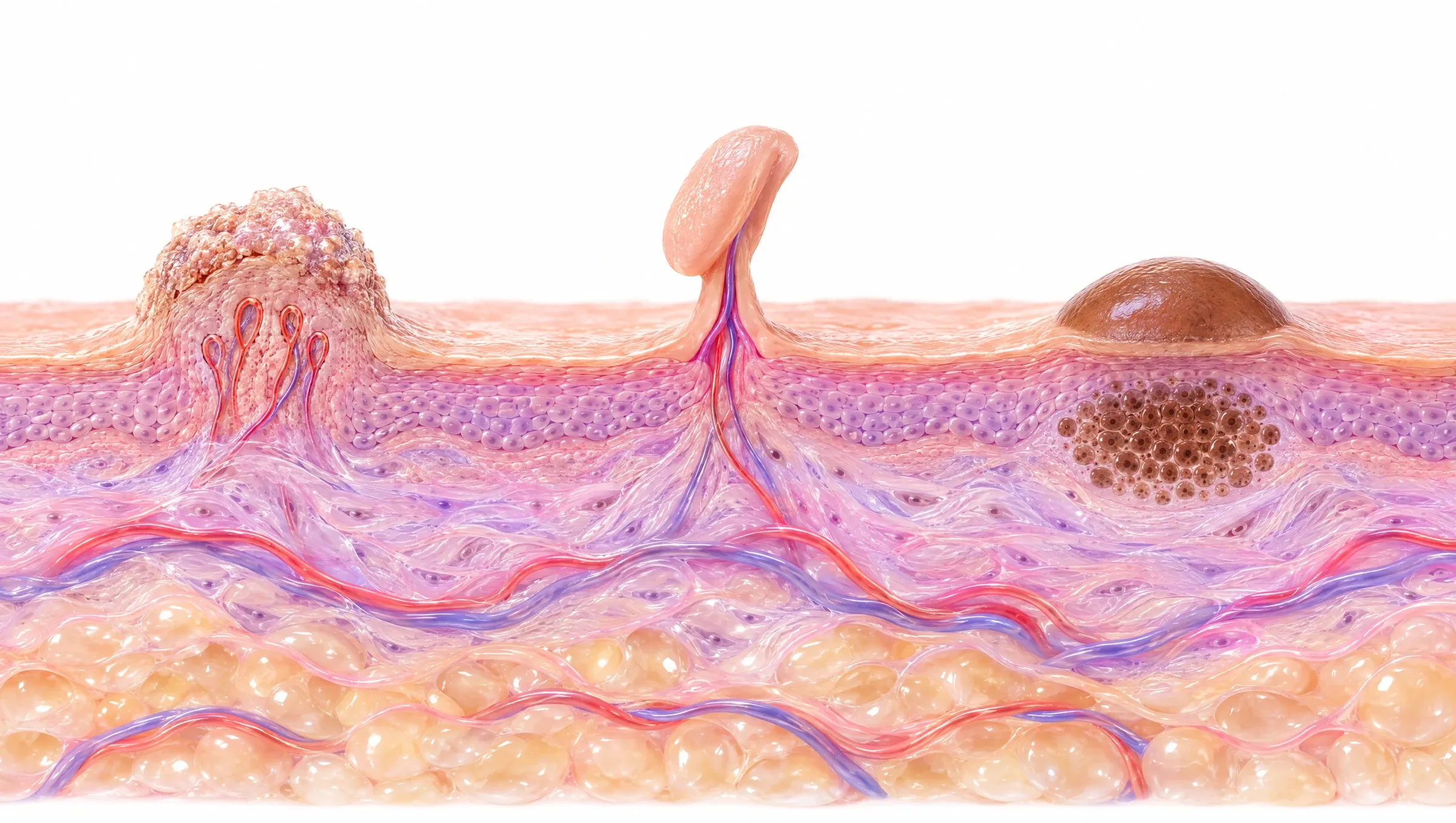
Illustration: a cross-section of skin with three growths side by side: a rough raised wart with tiny blood vessels inside, a soft skin tag on a thin stalk, and a smooth brown mole with a nest of pigment cells beneath it.
Illustration

What is it?

Compare common growths
ROUGH, RAISED, WITH TINY DOTS

Wart

Looks like
A rough, raised bump, often with tiny black dots; flat warts are smooth and small, often on the face. On the soles they can be painful.
Cause
Human papillomavirus (HPV); mildly contagious.
Usual removal
Freezing, electrocautery or radiofrequency, laser, or prescription treatments; several sessions may be needed.
SOFT FLAP ON A THIN STALK

Skin tag

Looks like
A soft, skin-coloured or brown flap on a thin stalk, on the neck, underarms, eyelids or groin.
Cause
Friction, age, weight gain, pregnancy, and insulin resistance or diabetes.
Usual removal
Quick snipping or radiofrequency under local anaesthetic; many can be removed in one visit.
EVEN COLOUR, ROUND, SMOOTH EDGE

Normal mole

Looks like
A round or oval spot, evenly brown or black, with a smooth edge, staying the same over time.
Cause
A cluster of pigment cells, present from childhood or appearing in young adulthood.
Usual removal
Only if wanted: shave or surgical removal; suspicious moles are removed whole and tested.
“STUCK-ON”, WAXY, WARTY

Seborrhoeic keratosis

Looks like
A waxy, rough, “stuck-on” brown growth, common on the face, chest and back from middle age. Small dark ones on the cheeks are called dermatosis papulosa nigra.
Cause
Age and genes; harmless and not contagious.
Usual removal
Radiofrequency, cautery, freezing or laser, for comfort or appearance.
UNEVEN SHAPE AND COLOUR

Mole to check

Warning signs (ABCDE)
Asymmetry, an irregular Border, more than one Colour, a Diameter larger than about 6 mm, or Evolving: changing in size, shape or colour.
Also
A new spot that looks different from your others, or one that bleeds, itches or doesn’t heal.
What to do
See a dermatologist promptly. The spot is examined and, if needed, removed whole and tested.

Illustrations, not to scale. Please don't diagnose yourself from pictures; a dermatologist examines growths with a dermatoscope before removal.

How growths are removed

Removal is usually a short procedure under local anaesthetic. The method depends on the growth: radiofrequency or electrocautery for warts, skin tags and keratoses; freezing (cryotherapy) for some warts; snip removal for tags; and shave or surgical excision for moles, with testing when needed. Small marks heal over one to two weeks and fade over months.

When to see a dermatologist

See a dermatologist for any mole or spot that is new, changing, bleeding or itching; for warts that are spreading, painful or on the face; for many skin tags, which may point to insulin resistance; and before any removal, so the growth is correctly identified.

How OrnaSkin helps

At OrnaSkin, a dermatology consultation identifies the growth, checks any mole that needs attention and plans removal if wanted. Wart and skin tag removal by radiofrequency or cautery, and mole removal by shave or excision, is done at the clinic in a short visit.

Your dermatologist

Dr. Smit Thakkar

MBBS, DDVL · Consultant dermatologist · leads OrnaSkin

At our Madhur Nagar skin clinic you are seen by Dr. Smit Thakkar himself, who examines your skin, explains your options plainly and plans the treatment with you.

About Dr. Smit Thakkar

Questions about warts, moles & skin tags

Are warts contagious?

Yes, mildly. Warts are caused by human papillomavirus (HPV) and can spread by direct contact, shared towels or razors, and from one part of your own body to another by picking or shaving. Covering them and not picking helps.

Can I remove a skin tag or mole at home?

Please don't. Cutting, tying or burning growths at home can cause bleeding, infection and scars, and a mole that should have been checked may be missed. Removal by a dermatologist is quick, done under local anaesthetic, and leaves a smaller mark.

Why do I get so many skin tags on my neck?

Skin tags are common with age, weight gain, pregnancy and diabetes or insulin resistance, and in areas of friction. Many small tags on the neck with dark, velvety skin may be a sign to check blood sugar.

Do warts go away on their own?

Many do, over months to a couple of years, especially in children. Treatment is worthwhile if they are painful, spreading, on the face or hands, or bothering you.

Will removing a mole make it cancerous?

No. Removing a mole doesn't cause cancer. A mole that looks unusual should be removed whole and sent for testing, rather than burnt off, so it can be examined.

Will it leave a scar?

Any removal leaves some mark, but with the right technique it is usually small and fades over months. In brown skin, temporary darkening can occur, which sun protection helps prevent. Tell us if you tend to form keloids.

Further reading

References

  1. British Association of Dermatologists' guidelines for the management of cutaneous warts 2014. Sterling JC, Gibbs S, Haque Hussain SS, et al. British Journal of Dermatology, 2014;171(4):696–712
  2. Early diagnosis of cutaneous melanoma: revisiting the ABCD criteria. Abbasi NR, Shaw HM, Rigel DS, et al. JAMA, 2004;292(22):2771–2776

This page explains a treatment in general terms and is not a diagnosis or a promise of results. Results vary from person to person. A dermatologist decides what is right for you after examining your skin. Read our medical disclaimer and editorial policy.

Treatments for warts, moles & skin tags.

Clinical dermatology

Dermatology consultation

A dermatology consultation is a visit with a qualified skin specialist for any skin, hair or nail problem, from acne, eczema, fungal infections and hives to hair loss and nail changes.

₹1,200 per visit
All treatmentsExplore every treatment at OrnaSkinLasers, skin, hair and injectables, planned by a dermatologist in Rajkot.See all

By appointment Dr. Smit Thakkar

Not sure what you need? Start here.

Book a consultation at OrnaSkin Madhur Nagar. Tell us what you would like to change and we will plan it with you.

Your bag

Your bag is empty.

Browse Orna Skincare